
IPAF Categories Explained: 1a, 1b, 3a & 3b, Which One Do You Need?
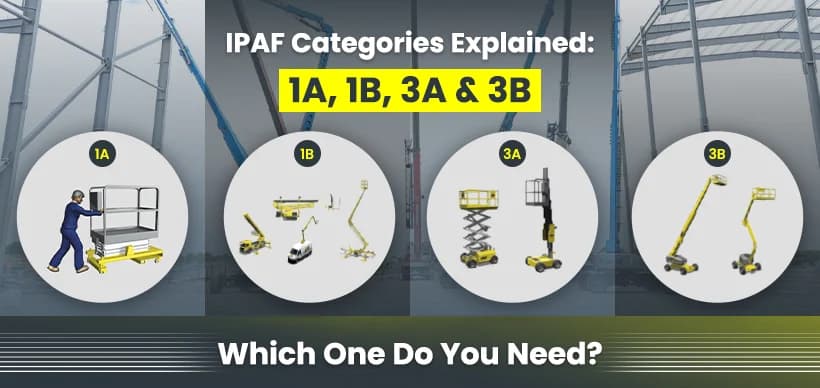
IPAF Categories Explained: 1a, 1b, 3a & 3b, Which One Do You Need?
IPAF category codes look cryptic until someone explains what the number and letter actually mean, and getting it wrong isn't a small mistake, since an operator certified in one category isn't automatically cleared to operate a machine in another. This guide breaks down exactly what 1a, 1b, 3a, and 3b mean, and which one your job actually needs.
For the full IPAF overview, see our pillar guide: The Complete Guide to IPAF Training: Courses, Categories & Certification.
The Two-Part Code, Explained
Every IPAF category code has two parts: a number (1 or 3) indicating whether the machine is static or mobile, and a letter (a or b) indicating whether it's a vertical platform or a boom.
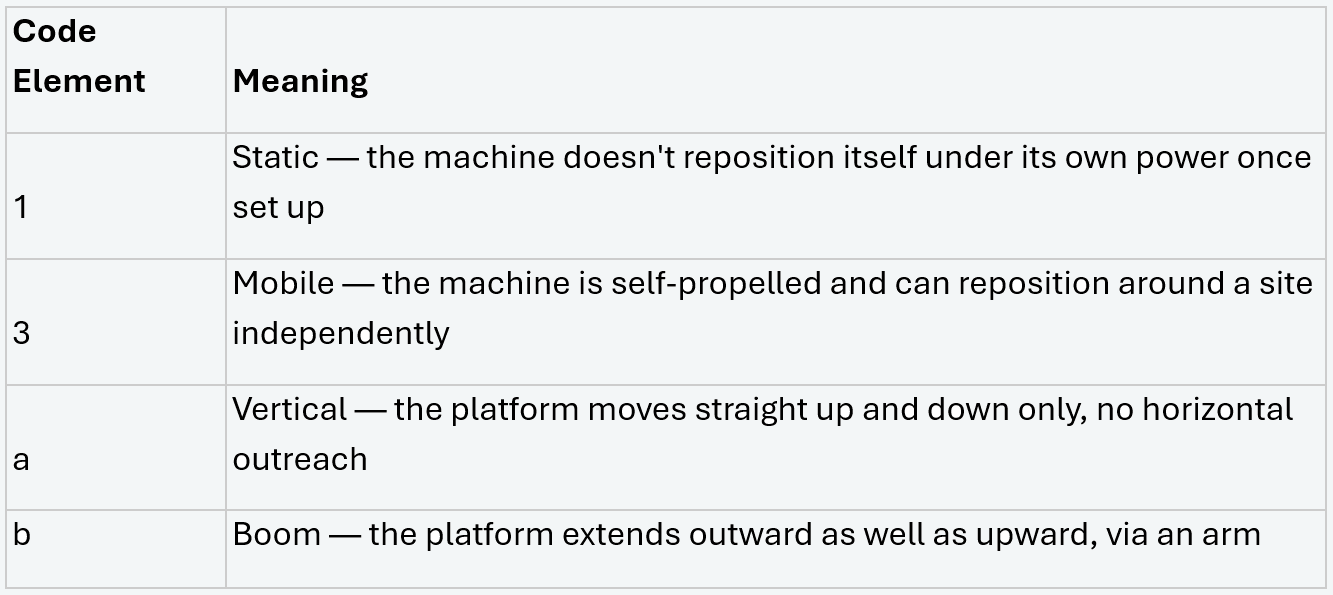
Once you know this, the four categories become straightforward.
IPAF 3a: Mobile Vertical
Category 3a is Mobile Vertical, the category covering self-propelled scissor lifts and other mobile vertical personnel platforms. These machines move straight up and down and reposition around a site under their own power. This is the most commonly required category on standard UK construction and warehouse sites, since scissor lifts are the default choice for straightforward, directly overhead access work.
For a full look at scissor lift training specifically, including what to expect on a 3a course, see our guide: Scissor Lift Training & Licence: Everything You Need to Get Certified.
IPAF 3b: Mobile Boom
Category 3b is Mobile Boom, covering self-propelled telescopic and articulated boom lifts, commonly known as cherry pickers, capable of both height and horizontal outreach, and able to reposition independently around a site. If your work needs to reach up and over an obstacle, or extend outward from where the machine can safely be positioned, 3b is the relevant category.
For cherry picker-specific training details, see our guide: Cherry Picker Training & Licence: A Complete Beginner's Guide.
IPAF 1a: Static Vertical
Category 1a is Static Vertical, vertical personnel platforms that don't reposition themselves under their own power once positioned. This is a less commonly requested category for general rental fleet work but remains relevant for specific static platform applications where a self-propelled machine isn't required or practical.
IPAF 1b: Static Boom
Category 1b is Static Boom, covering self-propelled booms with outriggers, trailer-mounted platforms, push-around units, and vehicle-mounted platforms. Many truck-mounted cherry pickers fall under this category rather than 3b, given their reliance on a vehicle chassis for road transport between jobs rather than independent site repositioning.
Dual 3a & 3b Training
Because scissor lifts and boom lifts are both extremely common across UK construction, industrial, and facilities sites, many operators need certification in both categories rather than just one. AFI Training's Dual 3a & 3b Operator course covers both machine types in a single programme, a more efficient route than booking two entirely separate single-category courses for operators who will realistically be running both machine types on the job. An e-learning version of the Dual 3a + 3b course is also available, moving the theory portion online ahead of an in-person practical assessment.
IPAF PAL PLUS 3a & 3b
For operators who already hold standard 3a and/or 3b certification and want to demonstrate a higher level of practical competence, IPAF PAL PLUS is an advanced assessment covering more complex operating scenarios than the standard operator course. It doesn't replace standard certification; it's an additional qualification layered on top, often sought by operators working in demanding environments or looking to strengthen their CV for more senior roles.
Does One Category Cover the Other?
No, this is the single most common misunderstanding about IPAF certification. A 3a certification (scissor lifts) does not automatically extend to 3b (boom lifts), and vice versa, even though both fall under the broader "mobile MEWP" umbrella. The controls, stability considerations, and hazards genuinely differ enough between vertical and boom-type machines that IPAF requires separate category-specific training and assessment for each. An operator moving from scissor lift work to a boom lift job for the first time needs 3b certification specifically, regardless of prior scissor lift experience.
How to Know Which Category You Need
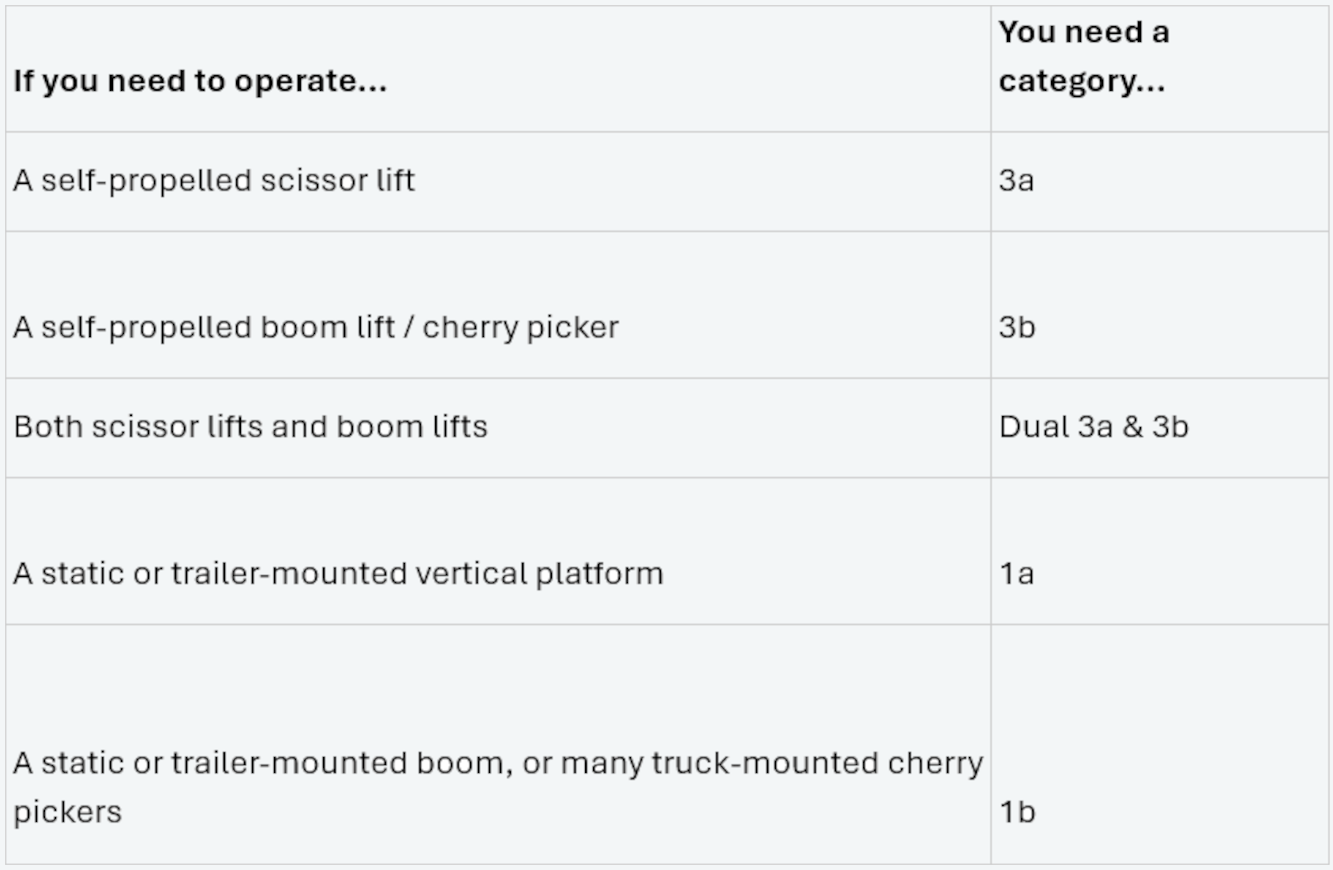
If your role or project changes over time, for example, moving from warehouse scissor lift work onto a construction site requiring boom lifts, additional category-specific training is needed before you're certified on the new equipment type.
Push-Around Vertical (PAV) Training
Push Around Vertical platforms are a smaller, manually repositioned type of vertical lift, commonly used for lighter indoor maintenance work such as retail fit-outs or office ceiling access. PAV training is typically delivered as a shorter, more focused course than full 3a certification, reflecting the simpler operation and lower working height typical of these machines, though it remains a distinct qualification rather than something covered automatically by 3a training.
Frequently Asked Questions
1. What does IPAF 3a mean?
IPAF 3a covers Mobile Vertical platforms, self-propelled scissor lifts and vertical personnel platforms that move straight up and down.
2. What does IPAF 3b mean?
IPAF 3b covers Mobile Boom platforms, self-propelled telescopic and articulated boom lifts, commonly known as cherry pickers.
3. What is the difference between IPAF 1a and 3a?
The number indicates mobility: 1 means static (doesn't reposition under its own power) while 3 means mobile (self-propelled), and both 1a and 3a cover vertical platforms specifically.
4. What does IPAF 1b cover?
IPAF 1b covers static boom equipment, including self-propelled booms with outriggers, trailer-mounted platforms, push-around units, and many vehicle-mounted cherry pickers.
5. Does IPAF 3a certification cover boom lifts too?
No, 3a covers scissor lifts and vertical platforms specifically, and does not extend to boom lift operation, which requires separate 3b certification.
6. What is Dual 3a & 3b training?
It's a single IPAF course covering both scissor lift (3a) and boom lift (3b) categories together, for operators who need certification on both machine types.
7. Is there an e-learning option for Dual 3a & 3b training?
Yes, AFI Training offers an e-learning version of the Dual 3a + 3b Operator course, moving the theory component online ahead of an in-person practical assessment.
8. What is IPAF PAL PLUS 3a & 3b?
PAL PLUS is an advanced assessment for operators who already hold standard category certification, demonstrating a higher level of practical competence in more complex operating scenarios.
9. Is IPAF cherry picker training the same as 3b?
Self-propelled cherry pickers typically fall under 3b, though many truck-mounted and trailer-based cherry pickers are classed under 1b instead, depending on the specific machine configuration.
10. Which IPAF category do I need for a standard construction scissor lift?
A standard self-propelled scissor lift falls under category 3a, Mobile Vertical.
11. Can an operator with 3a certification operate a 3b machine without additional training?
No, 3a and 3b are separate certifications with different training and assessment requirements, and operating a boom lift on 3a-only certification would not be properly credentialed.
12. What is Push Around Vertical (PAV) training?
PAV training covers manually repositioned vertical lift platforms, commonly used for lighter indoor maintenance work, and is typically a shorter, more focused course than full 3a certification.
13. Do I need a different course for a static platform versus a mobile one?
Yes, static platforms fall under category 1 (1a or 1b) while mobile, self-propelled platforms fall under category 3 (3a or 3b), and these require separate certification.
14. How do I know which IPAF category applies to the specific machine I'll be using?
Check the machine's category rating with your employer, site manager, or equipment supplier. If you're still unsure, our training team can help match the correct category to your specific equipment.
15. Can AFI Training advise which IPAF category my team needs?
Yes, our training team can assess which machines your operators will be running and recommend the correct category, or Dual course, for your team. Browse our IPAF courses or contact us to discuss your requirements.