
Cherry Picker Training & Licence: A Complete Beginner's Guide
Cherry Picker Training & Licence: A Complete Beginner's Guide
"Cherry picker" is the term almost everyone uses informally, even though it covers a couple of genuinely different IPAF categories depending on the specific machine. This guide walks through exactly what training and licensing you need to legally operate a cherry picker in the UK.
For the full IPAF category breakdown, see our guide: The Complete Guide to IPAF Training.
What Is a Cherry Picker?
A cherry picker is the everyday term for a boom-type mobile elevating work platform (MEWP), a machine with an extending arm that lifts a platform both upward and outward, allowing it to reach up and over obstacles rather than only straight up like a scissor lift. The term covers both self-propelled boom lifts that reposition around a site independently, and truck-mounted or trailer-based platforms built for road travel between job locations.
What Licence Do I Need to Operate a Cherry Picker?
The IPAF category you need depends on the specific type of cherry picker:
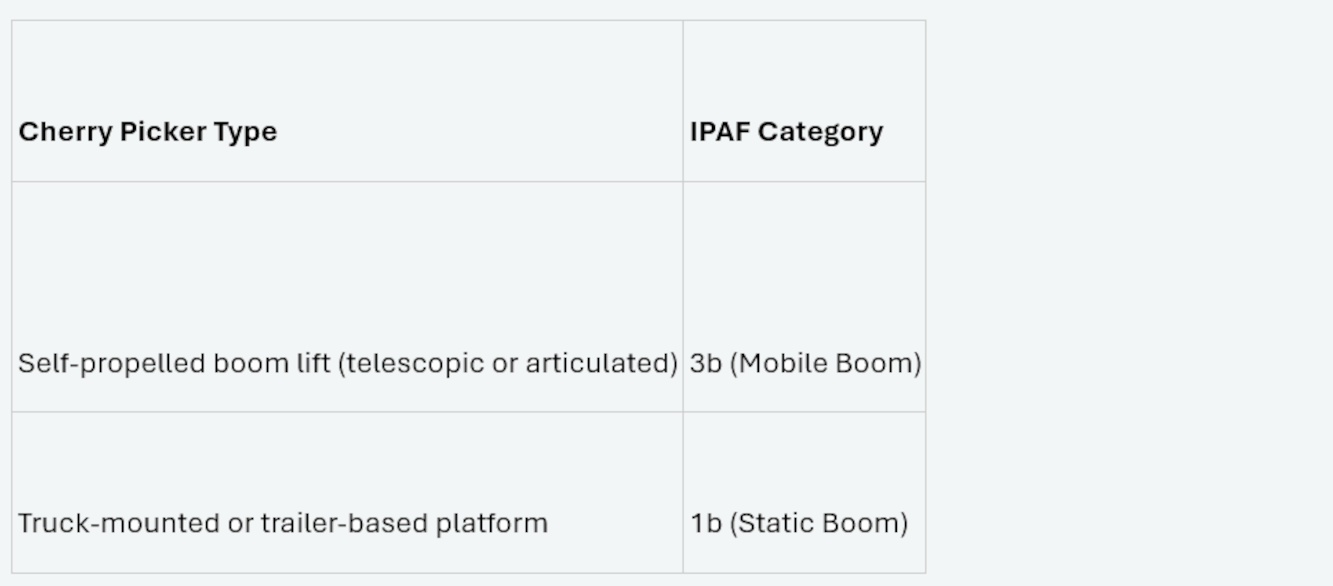
If you're not sure which type your job involves, check with your employer or equipment supplier, the category genuinely differs based on how the machine is transported and repositioned, not just its general "cherry picker" appearance.
What Does Cherry Picker Training Cover?
A standard IPAF boom course (3b or 1b, depending on the machine) combines theory and hands-on practical instruction, covering:
Pre-use inspection of the boom, platform, and chassis
Understanding outreach limits and load capacity
Safe positioning, including outrigger deployment where applicable
Manoeuvring the boom safely around obstacles
Correct use of fall-restraint harness equipment where required
Wind speed awareness and when to stop operating
Emergency descent and shut-down procedures
Assessment combines theory testing with a practical skills demonstration, and successful candidates receive an IPAF Certificate of Training and PAL Card for the relevant category.
Do Cherry Pickers Require a Harness?
Many boom lift tasks require the operator to wear a fall-restraint harness, correctly attached to the designated anchor point in the platform, given the additional risk of being thrown from the platform during sudden boom movement compared to the more stable scissor lift platform. If your role involves regular boom lift work, it's worth confirming whether you also need IPAF's dedicated Harness Awareness course alongside your operator category, we cover this in detail in our guide: IPAF Harness Training: Why It's Required and What the Course Covers.
How Long Does Cherry Picker Training Take?
A standard single-category course (3b or 1b) is typically completed in one day. If your role involves both scissor lifts and boom lifts, AFI Training's Dual 3a & 3b course covers both in a single, more efficient programme.
How Long Is a Cherry Picker Licence Valid?
Like all IPAF categories, cherry picker certification (3b or 1b) is valid for five years from the date of issue, after which renewal training is required to remain certified.
Cherry Picker Training Near You
AFI Training delivers IPAF boom lift training, both 3b and 1b, as well as combined Dual 3a & 3b courses, across 14 centres in the UK, with on-site training available where suitable for group bookings. As a CITB ATO Approved centre, eligible candidates may also access CITB grant funding of up to £140 toward course costs.
Is Cherry Picker Training Harder Than Scissor Lift Training?
Boom lift operation generally involves a steeper learning curve than scissor lift operation, given the added complexity of outreach control, outrigger stability assessment, and, depending on the machine, harness use. This is reflected in the course content itself rather than a longer course length in most cases, though candidates new to powered access equipment sometimes find booking scissor lift (3a) training first, before progressing to boom lift (3b), a more comfortable route into the industry, though this isn't a requirement, and many operators complete boom training as their first IPAF category.
For the broader MEWP training picture, see our guide: MEWP Training Guide.
Frequently Asked Questions
1. What licence do I need to operate a cherry picker?
You need IPAF category 3b for self-propelled boom lifts, or category 1b for truck-mounted or trailer-based platforms, depending on the specific machine type.
2. What does cherry picker training cover?
Training covers pre-use inspection, outreach and load limits, safe positioning, manoeuvring, harness use where required, wind speed awareness, and emergency procedures.
3. How long does cherry picker training take?
A standard single-category course (3b or 1b) is typically completed in one day, combining theory and practical assessment.
4. Do I need a harness to operate a cherry picker?
Many boom lift tasks require a fall-restraint harness correctly attached to the platform's designated anchor point; check whether your specific role requires IPAF's Harness Awareness course alongside operator training.
5. How long is a cherry picker IPAF licence valid?
A cherry picker PAL Card (category 3b or 1b) is valid for five years from the date of issue.
6. What's the difference between a 3b and 1b cherry picker?
3b covers self-propelled boom lifts that reposition independently around a site, while 1b covers truck-mounted or trailer-based platforms designed for road travel between locations.
7. Where can I find cherry picker training near me?
AFI Training operates 14 centres across the UK, with on-site training available for group bookings, use our course locator to find your nearest option.
8. Is cherry picker training the same as boom lift training?
Yes, "cherry picker" and "boom lift" refer to the same equipment category, and the training and IPAF certification are identical regardless of which term is used.
9. Can I get a combined cherry picker and scissor lift qualification?
Yes, AFI Training's Dual 3a & 3b course covers both categories together in a single programme.
10. Is cherry picker training harder than scissor lift training?
Boom lift operation generally has a steeper learning curve given outreach control and stability considerations, though course length is broadly similar to standard scissor lift training.
11. What happens if my cherry picker certification expires?
You're no longer certified to operate the machine commercially until you complete renewal training, typically meaning loss of site access for that work.
12. Can I get funding for cherry picker training?
Eligible candidates training with a CITB ATO Approved centre, such as AFI Training, may be able to access CITB grant funding toward course costs.
13. Do all cherry pickers require the same IPAF category?
No, the category depends on whether the machine is self-propelled (3b) or truck-mounted/trailer-based (1b), so it's worth confirming the specific machine type before booking.
14. Do I need cherry picker training if I already have a scissor lift licence?
Yes, scissor lift (3a) certification does not cover boom lift operation, so separate 3b or 1b training is required.
15. How do I book cherry picker training with AFI Training?
You can browse available 3b, 1b, and Dual 3a & 3b courses and book directly through our course finder, or contact our team for group or on-site training.