
IPAF Harness Training: Why It’s Required and What the Course Covers
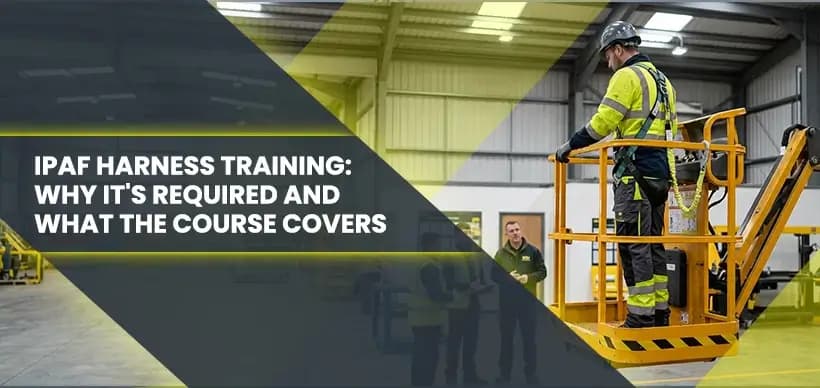
Operating a boom lift safely isn’t only about controlling the machine; for many boom lift tasks, correct harness use is what stands between a sudden platform movement and a serious fall. This guide explains what IPAF Harness Awareness training covers, when it’s required, and how it fits alongside standard operator certification.
For the full IPAF overview, see our pillar guide: The Complete Guide to IPAF Training | Courses & Certification.
Why Do Boom Lift Operators Need Harness?
Boom lifts, unlike scissor lifts, can experience sudden platform movement, particularly during a machine fault, collision, or contact with an obstacle that could throw an operator against or over the guardrail. A correctly fitted fall-restraint harness, attached to the platform’s designated anchor point, restrains the operator within the platform in this scenario, preventing a fall from height. This is why many boom lift tasks specifically require harness use, even though the platform itself has standard guardrails.
What Is IPAF Harness Awareness Training?
IPAF Harness Awareness is a dedicated course covering the correct selection, fitting, inspection, and use of fall-restraint harness equipment for MEWP work. It’s typically taken alongside standard operator category training (such as 3b for boom lifts) rather than as a replacement for it. Harness training addresses the personal protective equipment side of the job, while operator training addresses machine handling.
What Does the IPAF Harness Course Cover?
A standard IPAF Harness Awareness course covers:
Selecting the correct harness type and size for the individual and task
Correctly fitting and adjusting a harness before use
Pre-use inspection of the harness for wear, damage, or degradation
Correct attachment to the platform’s designated anchor point
Understanding restraint versus fall-arrest systems, and which applies to standard MEWP work
Safe storage and ongoing care of harness equipment between uses
Recognising when a harness should be taken out of service
Is a Harness Required for All MEWP Work?
No, harness requirements depend on the specific machine, task, and site risk assessment rather than applying universally across all MEWP categories. Scissor lift work generally doesn’t require a harness, given the platform’s stability and lack of sudden boom movement, while many, though not all, boom lift tasks do require one. Site-specific risk assessments, carried out by a competent person, should confirm harness requirements for a given task rather than assuming based on machine type alone.
How Often Does Harness Equipment Need Inspecting?
Harness equipment should be visually inspected before every use as part of standard pre-use checks, in addition to more thorough periodic inspection carried out at set intervals in line with the manufacturer’s guidance and UK Work at Height Regulations requirements. Any harness showing signs of wear, damage, or degradation should be taken out of service immediately rather than used until the next scheduled inspection.
Does Harness Training Expire?
IPAF Harness Awareness training doesn’t follow the same renewal cycle as category-specific operator certification in every case, but refresher training is generally recommended periodically to keep knowledge current, particularly around correct inspection technique and any updates to harness equipment or standards. Confirm with your training provider or employer how often harness refresher training is expected for your specific role.
For cherry picker-specific training, see our guide: Cherry Picker Training & Licence.
Who Should Take IPAF Harness Awareness Training?
Harness Awareness training is relevant for:
Boom lift operators whose tasks require harness use as part of standard operation
Operators working in environments where site risk assessments specify mandatory harness use regardless of machine type
Site supervisors responsible for confirming correct harness use and inspection compliance on site
Getting Harness Training Through AFI Training
AFI Training delivers IPAF Harness Awareness training alongside standard operator category courses across our 14 UK centres, allowing operators to complete both machine handling and harness competence in a coordinated booking rather than as entirely separate training events.
Frequently Asked Questions
1. What is IPAF Harness Awareness training?
It’s a dedicated course covering correct selection, fitting, inspection, and use of fall-restraint harness equipment for MEWP work, typically taken alongside operator category training.
2. Do I need harness training to operate a boom lift?
Many boom lift tasks require harness use, so harness training is often needed alongside category-specific operator training (such as 3b), though requirements depend on the specific task and site risk assessment.
3. Why do boom lifts require a harness but scissor lifts usually don’t?
Boom lifts can experience sudden platform movement during a fault or collision, which a harness restrains against, while scissor lift platforms are more stable and don’t carry the same risk profile.
4. What does an IPAF harness course actually cover?
It covers harness selection, correct fitting, pre-use inspection, attachment to the platform anchor point, and understanding restraint versus fall-arrest systems.
5. How often should harness equipment be inspected?
Harness equipment should be visually checked before every use, in addition to more thorough periodic inspection in line with manufacturer guidance and Work at Height Regulations requirements.
6. Does IPAF Harness Awareness training expire?
Refresher training is generally recommended periodically to keep knowledge current, though this doesn’t always follow the same five-year cycle as standard category certification; confirm requirements with your provider.
7. Is a harness required for all MEWP work?
No, requirements depend on the specific machine, task, and site risk assessment, and should be confirmed by a competent person rather than assumed based on machine type alone.
8. What’s the difference between restraint and fall-arrest systems?
Restraint systems prevent an operator from reaching a position where a fall could occur, while fall-arrest systems are designed to stop a fall already in progress. Standard MEWP harness use is typically a restraint system.
9. Who should take IPAF Harness Awareness training?
Boom lift operators whose tasks require harness use, operators on sites with mandatory harness policies, and supervisors responsible for confirming harness compliance.
10. Can harness training be booked alongside operator category training?
Yes, AFI Training delivers Harness Awareness training alongside standard operator courses such as 3b, allowing both to be completed in a coordinated booking.
11. What happens if a harness shows signs of wear during inspection?
It should be taken out of service immediately, rather than continuing to be used until the next scheduled inspection.
12. Is harness training the same as fall-arrest training generally?
Not necessarily. IPAF Harness Awareness training is specific to MEWP platform use, and may differ from broader fall-arrest training used in other working-at-height contexts such as roofing or scaffold work.
13. Does a harness attach anywhere on a boom lift platform?
No, it must be attached to the platform’s designated anchor point specifically, which is covered as part of correct harness training.
14. Do site risk assessments determine harness requirements?
Yes, a competent person’s site-specific risk assessment should confirm whether a given task requires harness use, rather than relying on general assumptions about machine type.
15. Can AFI Training deliver harness training for my whole team?
Yes, our team can arrange group Harness Awareness training alongside operator category courses across our 14 UK centres, or on-site where suitable. Contact us to discuss your requirements.