
MEWP Training Guide: Courses, Categories & Certification Explained
MEWP Training Guide: Courses, Categories & Certification Explained
MEWP is the umbrella term behind almost every powered access training course on the market, but if you're new to the industry, the terminology and course structure can be genuinely confusing. This guide explains what MEWPs actually are, how MEWP training is structured, and where IPAF fits into the picture.
For the full IPAF-specific overview, see our pillar guide: IPAF Training Explained: The Complete Guide.
What Does MEWP Stand For?
MEWP stands for Mobile Elevating Work Platform, the technical, regulatory term covering any powered platform designed to lift a person, along with tools and materials, to a working height. Scissor lifts, boom lifts, vertical mast lifts, and truck-mounted platforms are all types of MEWP. You may also see the equivalent US term "Aerial Work Platform" (AWP) used interchangeably in some contexts.
What Types of MEWP Are There?
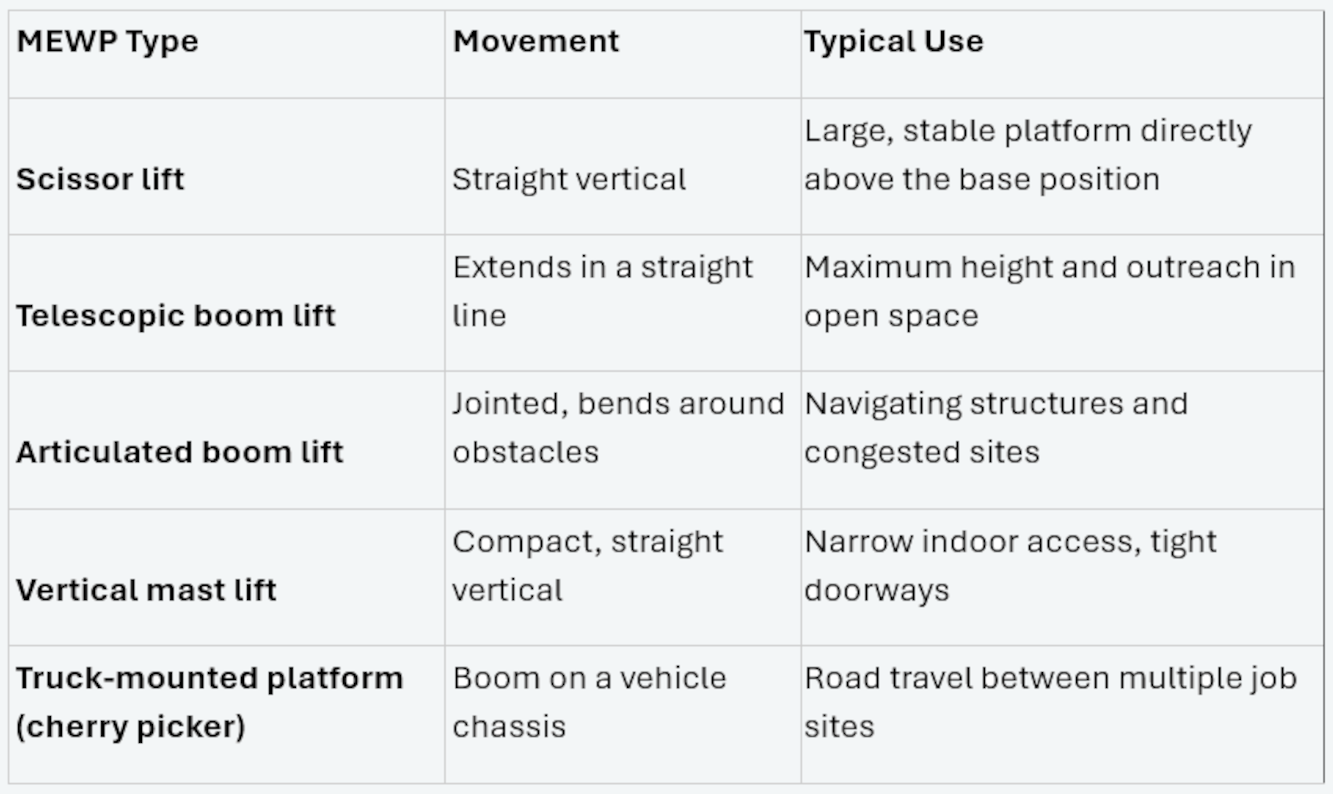
MEWPs fall into several broad types, each suited to different site conditions and reach requirements:
What Is MEWP Training?
MEWP training is any structured course teaching an operator to safely use one or more of these platform types. In the UK, the overwhelming majority of MEWP training is delivered under the IPAF framework, since IPAF's programme is certified to ISO 18878 and recognised across the vast majority of UK sites. When people search for "MEWP training," in practice they're almost always looking for IPAF-accredited operator training.
MEWP Training Categories
IPAF organises MEWP training by category code rather than as one blanket course, covering static and mobile platforms, and vertical and boom-type machines separately. We break down exactly what each code (1a, 1b, 3a, 3b) means in full detail in our dedicated guide, but as a quick summary: mobile, self-propelled platforms fall under category 3 (vertical = 3a, boom = 3b), while static or towed platforms fall under category 1 (vertical = 1a, boom = 1b).
MEWP Licence: What It Actually Means
There's no single "MEWP licence" in the way there is for driving a vehicle — instead, MEWP certification is category-specific, tied to the exact type of platform an operator has been trained and assessed on. Referring to someone's "MEWP licence" or "MEWP ticket" in the UK almost always means their IPAF PAL Card, showing which specific category or categories they're certified to operate.
What Does a MEWP Training Course Cover?
Regardless of category, a standard MEWP operator course covers a consistent set of core topics:
Awareness of different MEWP types and their intended uses
Safe operating principles and understanding each machine's limitations
Pre-use inspection and function testing before operation
Route planning before manoeuvring the machine into position
Correct positioning and stability considerations
Safe shut-down procedures
Use of fall-arrest equipment where the specific machine or task requires it
Assessment combines theory testing with a hands-on practical demonstration, and successful candidates receive a Certificate of Training and PAL Card for the specific category completed.
For exact category codes, see our guide: IPAF Categories Explained: 1a, 1b, 3a & 3b.
Finding MEWP Training Near You
AFI Training operates 14 approved training centres across the UK, and courses can also be delivered on-site at a suitable project location. Whether you need training on a single scissor lift category, a combined boom and vertical qualification, or a full team certified across multiple machine types, our team can match the right course to your specific MEWP fleet.
MEWP Training for Different Roles
MEWP training isn't only for hands-on operators. Site managers overseeing MEWP work benefit from IPAF's MEWPs for Managers course, which we cover in a dedicated guide, and experienced operators looking to demonstrate correct use to others can progress toward Demonstrator or Instructor training. This means a full site team's MEWP competence needs, from ground-level operators through to supervisors, can typically be addressed through the IPAF framework without needing separate, unrelated qualifications for each role.
MEWP Training vs Equipment-Specific Training
Some searches specifically look for "scissor lift training" or "cherry picker training" rather than the broader MEWP term, and while these are genuinely the same underlying IPAF categories (3a for scissor lifts, 3b for most cherry pickers), the practical experience and site context differ enough that we've covered each in its own dedicated guide: Scissor Lift Training & Licence and Cherry Picker Training & Licence.
Frequently Asked Questions
1. What does MEWP stand for?
MEWP stands for Mobile Elevating Work Platform, the umbrella term covering scissor lifts, boom lifts, vertical mast lifts, and other powered platforms used to lift a person to a working height.
2. Is MEWP training the same as IPAF training?
In practice, yes, the vast majority of MEWP training delivered in the UK follows the IPAF framework, since it's the recognised, ISO 18878-certified standard for the industry.
3. What is a MEWP licence?
There's no single "MEWP licence"; certification is category-specific, and what people typically mean by a MEWP licence or MEWP ticket is an IPAF PAL Card for the relevant machine category.
4. What is a MEWP ticket?
"MEWP ticket" is informal industry language for an IPAF PAL Card, the certification proof issued upon completing a category-specific MEWP training course.
5. How many types of MEWP are there?
The main types include scissor lifts, telescopic boom lifts, articulated boom lifts, vertical mast lifts, and truck-mounted platforms, each suited to different reach and site requirements.
6. What does a MEWP training course cover?
A standard course covers machine types and intended uses, safe operating principles, pre-use inspection, route planning, positioning, and safe shutdown, assessed through combined theory and practical testing.
7. Do I need different training for different types of MEWP?
Yes, MEWP training is issued by category, so a scissor lift certification (3a) doesn't automatically cover boom lift operation (3b), and vice versa.
8. Where can I find MEWP training near me?
AFI Training operates 14 centres across the UK, with on-site training also available at suitable project locations.
9. Is MEWP training required for managers who don't operate the equipment?
Managers overseeing MEWP work benefit from IPAF's MEWPs for Managers course specifically, which covers planning and supervision responsibilities rather than hands-on operation.
10. What is the difference between a MEWP and an AWP?
MEWP (Mobile Elevating Work Platform) is the UK and European term, while AWP (Aerial Work Platform) is the equivalent term more commonly used in the US; they refer to the same category of equipment.
11. Can one MEWP training course cover multiple machine types?
Yes, combined courses such as Dual 3a & 3b training cover both scissor lift and boom lift categories in a single programme.
12. How long is MEWP/IPAF certification valid?
An IPAF PAL Card, the standard proof of MEWP training, is valid for five years from the date of issue.
13. Is a scissor lift a type of MEWP?
Yes, a scissor lift is one of the main MEWP types, falling under IPAF category 3a (Mobile Vertical).
14. Is a cherry picker a type of MEWP?
Yes, a cherry picker is a boom-type MEWP, typically falling under IPAF category 3b (self-propelled) or 1b (truck-mounted or trailer-based).
15. Can AFI Training help me identify which MEWP course my team needs?
Yes, our training team can assess your fleet and recommend the correct category or combined course. Browse our courses or contact us to discuss your requirements.