
IPAF Instructor & Demonstrator Training: How to Become a Trainer
For experienced MEWP operators looking to progress their career, training and assessing other operators is a genuine next step, but it requires a specific pathway beyond standard operator certification. This guide covers both the IPAF Demonstrator and Instructor routes, what each involves, and who’s eligible.
For the full IPAF overview, see our guide: The Complete Guide to IPAF Training: Courses, Categories & Certification.
Demonstrator vs Instructor: What’s the Difference?
These two routes are often confused, but they serve different purposes:
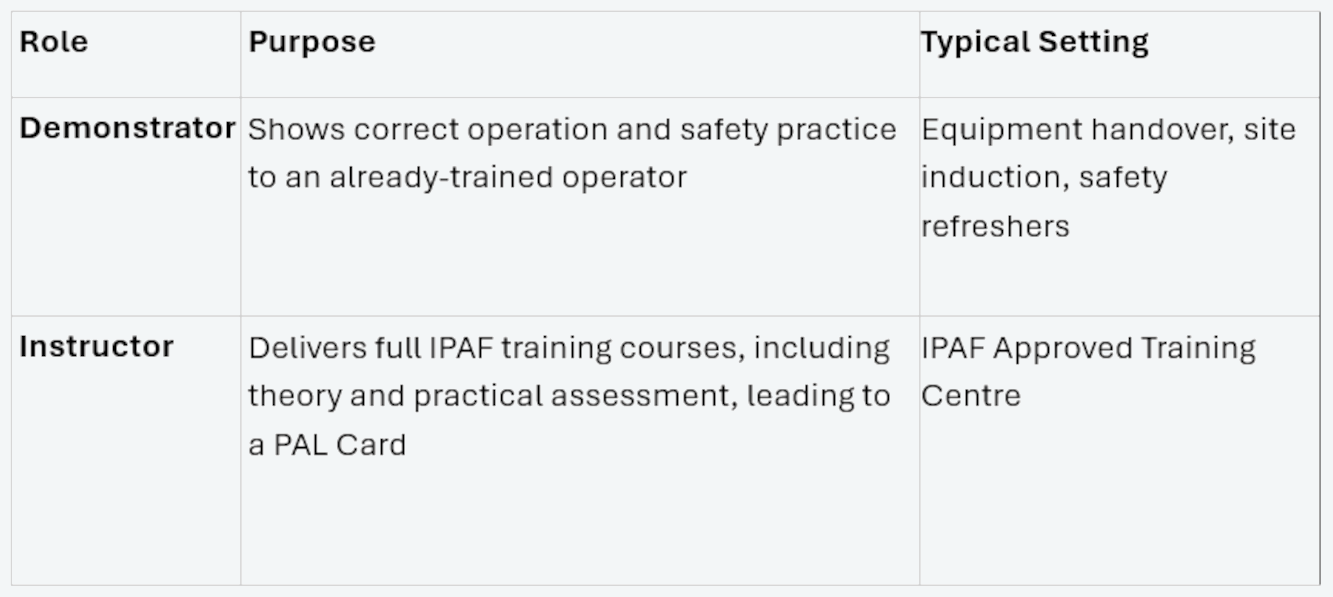
A Demonstrator briefs and shows; an Instructor formally trains and certifies. Both routes build on strong existing operator experience, but Instructor status is the more advanced, broader qualification.
What Is the IPAF Demonstrator Course?
The Demonstrator course is designed for certified operators who need to demonstrate correct operation and safety practices to others, for example, during equipment handover on a rental site, at site induction, or during a safety refresher briefing, rather than delivering full instructor-led training from scratch.
Who Can Take the Demonstrator Course?
Candidates must already hold an in-date PAL Card in the relevant category (3a and/or 3b), since the course builds on existing certified competence rather than teaching operation from zero. It’s not an entry-level course; it’s a progression step for operators who already know how to run the machine and now need to communicate that safely and clearly to someone else.
What Does the Demonstrator Course Cover?
The course covers the same machine categories as standard operator training, but shifts focus toward demonstration technique:
Clearly communicating safe operation to a trained operator
Correctly explaining pre-use checks and defect reporting procedures
Modelling proper handover practice for rental or transferred equipment
Recognising and correcting unsafe habits in an operator during a demonstration or briefing
This makes it particularly relevant for site supervisors, senior operators, or equipment handover personnel who regularly brief others on correct machine use, even without formally delivering full training courses.
IPAF Load and Unload / Site Assessment Training
Beyond core Demonstrator skills, some progression routes also cover load and unload procedures and site assessment competence, relevant for personnel responsible for safely getting MEWPs on and off transport vehicles, and for assessing a site’s suitability for specific machine types before work begins. These skills often sit alongside Demonstrator-level responsibility, particularly for rental company staff and senior site personnel.
What Is IPAF Instructor Training?
IPAF Instructor training is a separate, more advanced qualification for individuals who will go on to deliver full IPAF training courses to others, including both theory instruction and practical assessment leading to a PAL Card. This requires a stronger existing foundation in powered access equipment operation and safety knowledge than the Demonstrator route, since instructors need to both demonstrate correct technique and effectively assess whether a candidate has reached the required competence standard.
For the broader MEWP training picture, see our guide: MEWP Training Guide.
How Do I Become an IPAF Instructor?
Instructor training is administered through IPAF’s approved instructor pathway, generally requiring significant prior operating experience across relevant categories, followed by instructor-specific training and assessment. This represents a meaningfully bigger commitment than either standard operator certification or the Demonstrator course, reflecting the responsibility of being the person who ultimately certifies other operators as competent.
Career Progression: From Operator to Instructor
A typical progression path looks like:
Standard operator certification (3a, 3b, or relevant category)
Building practical experience through logged operating hours across real job tasks
PAL PLUS (optional but common) — demonstrating advanced practical competence
Demonstrator course — learning to brief and show correct operation to others
Instructor training — the full pathway to delivering formal IPAF courses
Not every operator needs to follow this full path; many are well served stopping at standard certification or PAL PLUS. But for those aiming toward a training or supervisory career within powered access, this is the recognised route.
Training Through AFI Training
As an IPAF Approved Training Centre with 25+ years of industry experience, AFI Training can advise on Demonstrator course eligibility and discuss the Instructor pathway for operators looking to progress their career within powered access training.
Frequently Asked Questions
1. What is an IPAF Demonstrator?
An IPAF Demonstrator is a certified operator trained to demonstrate correct MEWP operation and safety practices to others, typically during equipment handover or site briefings.
2. What is an IPAF Instructor?
An IPAF Instructor is qualified to deliver full IPAF training courses, including theory instruction and practical assessment, leading to a PAL Card for candidates.
3. What’s the difference between a Demonstrator and an Instructor?
A Demonstrator shows and briefs already-trained operators on correct practice; an Instructor formally trains and certifies new operators from the ground up.
4. Do I need a PAL Card before taking the Demonstrator course?
Yes, candidates must already hold an in-date PAL Card in the relevant category, since the course builds on existing certified competence.
5. What does the IPAF Demonstrator course cover?
It covers communicating safe operation clearly, explaining pre-use checks and defect reporting, and modelling correct handover practice for equipment.
6. How do I become an IPAF Instructor?
Instructor training is administered through IPAF’s approved instructor pathway, generally requiring substantial prior operating experience followed by instructor-specific training and assessment.
7. Is Instructor training harder to qualify for than Demonstrator training?
Yes, Instructor status is a more advanced qualification requiring a stronger existing foundation, since instructors both demonstrate technique and formally assess candidate competence.
8. What is IPAF load and unload training?
It covers safely getting MEWPs on and off transport vehicles, relevant for rental company staff and senior site personnel involved in equipment logistics.
9. What is IPAF site assessment training?
It covers assessing a site’s suitability for specific MEWP types before work begins, often relevant alongside Demonstrator-level responsibilities.
10. Who typically takes the Demonstrator course?
Site supervisors, senior operators, and equipment handover personnel who regularly brief others on correct machine use.
11. Can I go straight from standard operator certification to Instructor training?
Typically not directly, most operators build experience and often complete PAL PLUS and/or Demonstrator training before progressing toward the Instructor pathway.
12. Does Demonstrator training count as formal operator training for someone else?
No, a Demonstrator briefs and shows correct practice to an already-trained operator; formally training and certifying a new operator requires an Instructor delivering a full IPAF course.
13. Is PAL PLUS required before Demonstrator training?
It’s not a strict requirement, but many operators pursue PAL PLUS as part of building the advanced practical competence expected at Demonstrator level.
14. Can AFI Training advise on the Instructor pathway?
Yes, as an IPAF Approved Training Centre with over 25 years of industry experience, our team can discuss eligibility and next steps for operators interested in progressing toward Instructor status.
15. How do I book Demonstrator training with AFI Training?
Contact our team directly to confirm your eligibility (an in-date relevant PAL Card) and arrange a Demonstrator course at one of our UK training centres.