
IPAF Jobs: Career Paths, Salaries & How Certification Helps You Get Hired
Holding an IPAF PAL Card doesn’t just get you access to a work site; for many roles, it’s genuinely the deciding factor in whether you get hired at all. This guide covers where IPAF certification opens doors, what employers actually look for, and how to progress an IPAF-based career over time.
For the full IPAF overview, see our pillar guide: The Complete Guide to IPAF Training: Courses, Categories & Certification.
Why IPAF Certification Matters for Job Applications
Across UK construction, facilities management, and industrial sectors, IPAF certification is frequently listed as an essential requirement, not just a preferred skill, on job postings involving MEWP operation. This is largely because employers carry legal responsibility under the Work at Height Regulations 2005 to ensure operators are properly trained, making an uncertified candidate a genuine compliance risk regardless of informal experience. For many roles, “must hold current IPAF certification” filters out applications before any other qualification is even considered.
What Jobs Require IPAF Certification?
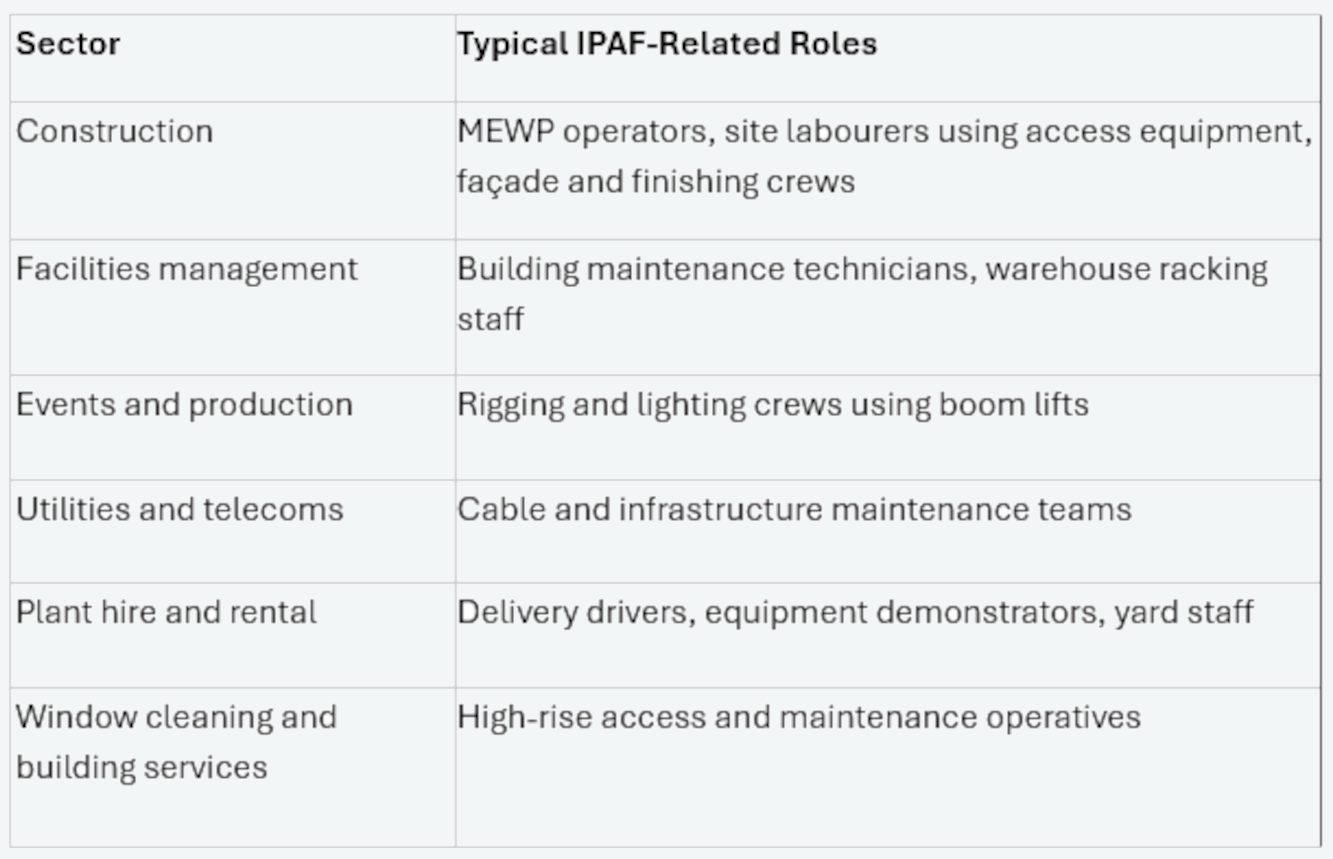
IPAF-certified operators are needed across a wide range of roles and sectors:
Which IPAF Category Do Employers Look For?
This depends entirely on the role and sector. Warehouse and facilities roles typically require 3a (scissor lift) certification as a baseline, while construction and outdoor maintenance roles more often require 3b (boom lift) or Dual 3a & 3b certification, given the broader range of access challenges those environments present. Reading the specific job posting carefully, rather than assuming any IPAF category is interchangeable, matters, since employers are often specific about which category the role actually requires.
Does IPAF Certification Affect Pay?
Certified operators are generally more employable than uncertified candidates for the same roles, since the certification removes a compliance barrier that would otherwise exclude them entirely. Beyond entry-level roles, operators with a broader category range (such as Dual 3a & 3b) or advanced qualifications like PAL PLUS are often positioned for higher-paying or more senior roles, since they can be deployed more flexibly across a wider range of tasks and equipment. Specific salary figures vary significantly by region, sector, and experience level, so it’s worth researching current listings for your specific role and area rather than relying on a single average figure.
Career Progression Within IPAF Certification
A typical IPAF-based career path looks like this:
Entry-level operator certification: typically 3a (scissor lift) or 3b (boom lift), depending on the sector
Broadening category coverage: adding Dual 3a & 3b, or additional categories like 1a/1b, to increase employability
PAL PLUS: demonstrating advanced practical competence, useful for more demanding or senior operator roles
Demonstrator training: for operators who take on responsibility for briefing others during handover or induction
Instructor pathway: for those aiming toward a training-focused career, delivering IPAF courses to new operators
We cover the Demonstrator and Instructor routes in full detail in our guide: IPAF Instructor & Demonstrator Training: How to Become a Trainer.
How to Make Your IPAF Certification Stand Out to Employers
Keep your logbook up to date: a well-maintained logbook demonstrates consistent, varied practical experience, not just a certificate on paper
Consider broadening your categories: operators certified across both 3a and 3b are more flexible hires than single-category operators
Renew before expiry, not after: a lapsed PAL Card, even briefly, can raise questions during hiring; renewing four to six weeks ahead avoids this entirely
Add relevant add-on training: Harness Awareness certification, where relevant to your target roles, signals broader competence beyond the base operator qualification
Finding IPAF Operator Jobs
IPAF-certified roles are typically advertised through standard construction and industrial job boards, recruitment agencies specialising in plant and construction trades, and directly through plant hire and construction companies. Searching specifically for the category you hold (e.g., “3a scissor lift operator” rather than just “MEWP operator”) often surfaces more precisely matched roles.
Getting Certified to Start Your IPAF Career
AFI Training delivers IPAF operator training across 14 UK centres, and as a CITB ATO Approved provider, eligible candidates may access grant funding toward course costs, a practical starting point whether you’re entering the industry for the first time or adding a category to an existing certification.
Frequently Asked Questions
1. Do I need IPAF certification to get a MEWP operator job?
In most cases, yes, many UK employers list current IPAF certification as an essential requirement given their legal responsibility for operator competence under the Work at Height Regulations 2005.
2. What jobs require IPAF training?
Roles across construction, facilities management, events, utilities, and plant hire that involve operating scissor lifts, boom lifts, or other MEWPs typically require IPAF certification.
3. Which IPAF category do employers look for most?
This varies by sector; facilities and warehouse roles often require 3a, while construction and outdoor roles more often require 3b or Dual 3a & 3b certification.
4. Does IPAF certification increase my chances of getting hired?
Yes, since it removes a compliance barrier that would otherwise exclude uncertified candidates from MEWP operator roles entirely.
5. Does having multiple IPAF categories increase my pay?
Operators with broader category coverage or advanced qualifications like PAL PLUS are often positioned for more flexible, higher-responsibility roles, though specific pay varies by region and sector.
6. What is the typical career progression for an IPAF-certified operator?
A common path moves from entry-level single-category certification through broader category coverage, PAL PLUS, and potentially Demonstrator or Instructor training.
7. Can I find IPAF operator jobs near me?
Yes, IPAF-certified roles are advertised on standard construction and industrial job boards, through specialist recruitment agencies, and directly by plant hire and construction firms.
8. Does a lapsed IPAF certificate affect my job prospects?
Yes, a lapsed PAL Card can raise questions during hiring or site induction, which is why renewing four to six weeks before expiry is recommended.
9. What’s the difference between an IPAF operator and an IPAF Demonstrator role?
An operator runs the machine for their own work tasks; a Demonstrator additionally briefs and shows correct operation to others, typically a progression from standard operator experience.
10. Do I need a specific IPAF category to work in events or production?
Boom lift certification (3b) is commonly required for rigging and lighting work in events and production, given the outreach needs of that kind of access work.
11. Can IPAF certification lead to a full-time training career?
Yes, experienced operators can progress toward Demonstrator and then Instructor status, eventually delivering IPAF training to new operators as a career path.
12. Is IPAF certification recognised by all UK employers?
IPAF is the dominant, widely recognised standard across UK construction and industrial sectors, though individual employers may have additional site-specific requirements alongside it.
13. How do I keep my IPAF certification relevant for job applications over time?
Maintain your logbook with regular entries, renew before expiry, and consider broadening your category coverage as your career progresses.
14. Does location affect demand for IPAF-certified operators?
Yes, demand varies by region depending on local construction and industrial activity; searching current listings for your specific area gives the most accurate picture.
15. How do I get started on an IPAF career with AFI Training?
Book entry-level operator training through our course finder. As a CITB ATO Approved centre, eligible candidates may access grant funding to help offset the cost of getting started.