
PASMA Training Online vs Onsite: Which Option Is Right for You?
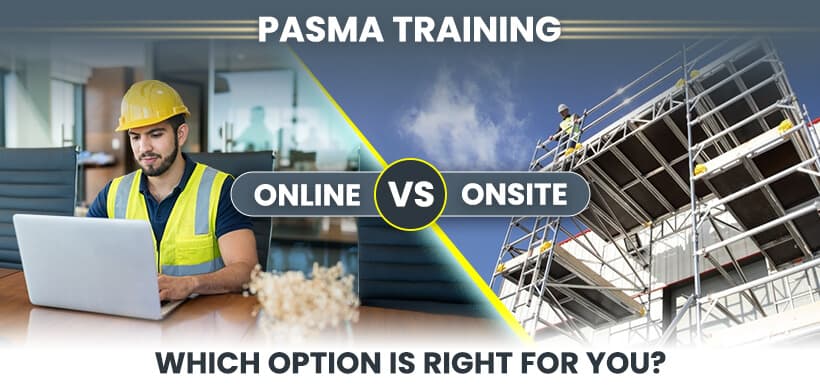
If you are searching for PASMA training online, you may be wondering whether you can complete the whole qualification from home or whether you need to attend a training centre.
The answer depends on the PASMA course you need.
Some PASMA courses offer e-learning for the theory part, but practical tower training and assessment still require practical participation. For example, PASMA Towers for Users includes both theory and practical assessment. E-learning can be available for the theory section, but it does not remove the practical requirement.
This means online PASMA training is not always a complete replacement for face-to-face training.
For some learners, a blended approach can work well. Theory can be completed online where available, followed by an in-person practical session. For businesses with several employees, onsite PASMA training may also be a useful option.
This guide explains the differences between online, classroom and onsite PASMA training, what can be completed online and how to choose the right option.
For a wider overview of PASMA courses, cards and qualifications, read our PASMA Training Explained: The Complete Guide to Courses, Cards & Certification.
What Is PASMA Online Training?
PASMA online training usually refers to the e-learning element available for certain PASMA courses.
It is important to understand that online learning, remote training and practical training are different things.
Online learning normally allows a delegate to study theory using digital course material. This can be useful for people who need more flexibility around work and other commitments.
However, some PASMA qualifications also include practical training and assessment.
For example, Towers for Users covers practical activities such as:
● Tower assembly
● Dismantling
● Safe movement
● Inspection
● Hazard awareness
● Safe use
These skills need to be demonstrated in practice.
Therefore, when you see a PASMA course online, always check exactly which parts of the course are available online.
Can You Complete PASMA Training Completely Online?
For practical tower-user qualifications, you should not assume that the complete qualification can be finished online.
PASMA Towers for Users includes theory and practical assessment. The theory section can be supported by e-learning where available, but the practical part remains an important part of the qualification.
This is because knowing the correct procedure is different from being able to carry it out safely.
A worker may understand how a tower should be assembled from online training, but they still need to demonstrate the correct practical skills.
The same principle applies to other practical PASMA qualifications.
Before booking an online course, check:
Question | Why it matters
Is e-learning available? | Not every course has the same online options
Is the theory completed online? | Online delivery may only cover theory
Is practical training required? | Practical qualifications need hands-on learning
Where is the practical assessment? | You may still need to attend a centre
Is remote delivery available? | This depends on the course and training centre
Is the course PASMA-approved? | The qualification should match your training needs
This prevents confusion between a genuine PASMA qualification and a general online access-tower awareness course.
How Does PASMA E-Learning Work?
Where e-learning is available, the delegate completes the theory element using online learning material.
This can make the training process more flexible.
A typical blended arrangement may involve completing the theory first and then attending a practical training session.
The exact process depends on the course and training provider.
For example, the theory and practical elements of Towers for Users cover different learning needs:
Theory | Practical
Regulations and responsibilities | Tower assembly
Tower components | Tower dismantling
Hazards | Safe movement
Inspection requirements | Practical checks
Safe working principles | Safe use
Online theory can prepare the learner for the practical part, but both areas remain important.
Online PASMA Training vs Classroom Training
Online theory and classroom learning both have advantages.
Online learning provides flexibility, while classroom training gives delegates direct contact with an instructor.
● Online learning
Online theory may suit workers who:
● Have busy schedules
● Work across different locations
● Prefer flexible study
● Want to complete theory before practical training
● Need to reduce travel for the theory element
The learner can usually work through the available material at a suitable time.
● Classroom training
Classroom training may be better for people who prefer direct instruction.
It can be particularly useful for workers who are new to access equipment and want to ask questions during the course.
Face-to-face learning also allows the instructor to explain subjects in real time and respond to areas where delegates need more support.
Neither method is automatically better. The right option depends on the course and learner.
What Is Onsite PASMA Training?
Onsite PASMA training means the training provider delivers the course at the customer's workplace or another suitable location arranged by the business.
This can be particularly useful when several employees need the same qualification.
Instead of sending each employee to a public training centre, an employer may be able to arrange one training session for the group.
The training area must be suitable for the course, particularly where practical tower training is involved.
The provider should confirm the site requirements before the course takes place.
Benefits of Onsite PASMA Training
Onsite training can offer several practical benefits for businesses.
● Less employee travel
Workers can avoid travelling to a separate training centre.
This may save time and reduce disruption to the working day.
● Group training
A company can train several suitable employees together.
This can be useful when multiple workers need the same PASMA qualification.
● Convenient location
Training can take place at the business location, provided the site is suitable.
This can make planning easier for companies with established training areas.
● Flexible arrangements
Some training providers can arrange training around business requirements, subject to availability and course conditions.
● Reduced disruption
Sending several workers away for different training dates can be difficult for employers.
An onsite session can allow the business to organise training for a group at one time.
However, onsite training is not automatically the best choice for every company.
When Is Public PASMA Training Better?
Public training at a dedicated centre may be more suitable for individual workers or small teams.
It can be a good option when:
● Only one or two employees need training
● The workplace does not have suitable practical space
● Employees work at different locations
● You need a particular course date
● You prefer a dedicated training environment
● Onsite delivery is not available for the required course
For an individual worker, travelling to a public course may be simpler than arranging an onsite session.
PASMA Training Online for Employees
Online theory can be useful for employees who work from different locations.
For example, a business may have workers spread across several parts of the UK. Completing available theory online can reduce the need for every employee to travel for that part of the course.
However, employers should still check the complete qualification requirements.
Online theory does not automatically provide practical competence.
Workers who assemble, dismantle, move or use mobile access towers still need the practical skills required for their role.
What Does PASMA Practical Training Cover?
The practical element allows delegates to use access tower equipment under the guidance of an instructor.
For a Towers for Users course, practical activities can include:
● Correct tower assembly
● Dismantling procedures
● Safe movement
● Inspection
● Identifying unsafe conditions
● Correct use of the tower
The practical assessment checks whether the delegate can apply the knowledge covered during the course.
This is why online theory should be viewed as part of the training process rather than a replacement for practical learning.
Which PASMA Courses Offer E-Learning?
Online availability depends on the individual course.
PASMA currently lists e-learning for the theory section of Towers for Users.
The Combined Towers and Low-Level Access course also offers e-learning for its theory component.
Other PASMA courses may have different arrangements.
For this reason, check the current delivery options for the exact qualification you need before booking.
Do not assume that because one PASMA course offers e-learning, every PASMA course can be completed in the same way.
Can PASMA Training Be Done Remotely?
Remote training and e-learning are not the same.
E-learning normally involves working through digital course material.
Remote training may involve live instruction without being physically present with the instructor.
The availability of remote training varies between courses.
Some PASMA course information advises delegates to check remote delivery with the training centre.
If remote training is important to you, ask the provider:
1. Can the theory be completed remotely?
2. Is live online instruction available?
3. Can the assessment be completed remotely?
4. Is practical attendance still required?
5. Where will practical training take place?
This will give you a clear picture of what you actually need to attend in person.
PASMA Course Weekend Options
Some workers specifically search for a PASMA course weekend because taking time off during the working week can be difficult.
Weekend availability depends on the training provider, course and date.
Weekend training may suit:
● Contractors
● Self-employed workers
● Employees with weekday commitments
● Businesses that cannot release staff during normal working hours
However, you should always check whether the exact PASMA course is available on weekends.
If the theory is available through e-learning, this may provide additional flexibility, but the required practical session still needs to be arranged.
Online PASMA Training vs Onsite Training
Online and onsite training solve different problems.
Online learning mainly provides flexibility for the theory element.
Onsite training mainly provides convenience for businesses and groups.
Feature | Online / E-learning | Onsite PASMA
Flexible theory | Yes, where available | Course dependent
Face-to-face instruction | Course dependent | Yes
Practical training | Still required where applicable | Yes
Practical assessment | Required where applicable | Yes
Employee travel | Reduced for theory | Can be reduced
Group training | Course dependent | Suitable for groups
Training at workplace | No | Yes
Best suited to | Flexible learning | Business teams
The two options can also work together.
For example, employees may complete theory online and then attend a practical session delivered onsite.
Which Option Is Best for a Single Worker?
For one worker, a public training centre will often be the straightforward option.
The employee can attend the available course date and complete the theory and practical elements as required.
If e-learning is available, it may provide additional flexibility before attending the practical session.
An onsite course may be less practical for a single delegate unless there is a particular reason to train at the workplace.
The decision should be based on availability, location, course requirements and the employee's working arrangements.
Which Option Is Best for a Group?
For a group of employees, onsite PASMA training may be worth considering.
A business can potentially train several suitable employees together instead of arranging multiple individual bookings.
This can also make scheduling easier.
Before choosing onsite training, check:
● Number of delegates
● Course type
● Available training dates
● Suitable practical space
● Equipment requirements
● PPE requirements
● Instructor availability
The training provider can then confirm whether the workplace is suitable.
Does Online Training Remove the Need for Practical Skills?
No. This is one of the most important points to understand when comparing online PASMA training with other options.
Online learning can provide theoretical knowledge.
It cannot, by itself, demonstrate that a worker can safely assemble or dismantle a tower.
Practical training allows delegates to develop and demonstrate the skills needed to work with the equipment.
For practical PASMA qualifications, both knowledge and practical ability are important.
PASMA Training and Competence
The right training should match the worker's actual responsibilities.
Someone who physically assembles and dismantles towers has different practical requirements from someone who only manages or supervises tower users.
PASMA has different courses for different roles and levels of responsibility.
Employers should therefore identify the work their employees will carry out before choosing an online, classroom or onsite option.
The delivery method is important, but the correct qualification comes first.
If you want to understand how PASMA cards and certification work after completing training, see our PASMA Card & Certificate: How to Get, Check & Renew Your PASMA Ticket.
Onsite PASMA Training for Businesses
Onsite delivery can work well for businesses where several workers use access towers.
This can include teams working in:
● Construction
● Facilities management
● Building maintenance
● Electrical installation
● Mechanical maintenance
● Industrial maintenance
● Events
● Installation work
The benefit is that workers can complete suitable training together at one location.
The workplace must still meet the training provider's requirements.
Practical training should never be arranged in an unsuitable area simply for convenience.
What Is Needed for Onsite PASMA Training?
The exact requirements depend on the course.
For practical tower training, the site needs enough suitable space for delegates to carry out the required activities safely.
The employer may also need to arrange suitable:
● Access tower equipment
● Training area
● PPE
● Safe working conditions
The training provider should confirm these requirements before the course.
This is especially important when a business is arranging training at its own workplace.
What PPE Is Needed?
PPE requirements depend on the course and training environment.
For practical tower training, delegates may need suitable head protection, safety footwear and gloves.
The training provider should confirm the exact requirements before attendance.
For onsite training, employers should make sure that all delegates have the required PPE before the practical session begins.
How Do You Choose the Right PASMA Training Format?
A simple approach is to consider four things.
● Number of delegates
One employee may suit a public course.
A larger group may benefit from onsite training.
● Course requirements
If the qualification includes practical assessment, make sure the training plan includes an in-person practical element.
● Location
Employees working from different locations may benefit from online theory where available.
Employees based at one workplace may benefit from onsite delivery.
● Schedule
Consider weekday and weekend options, and available e-learning and practical session dates.
The most convenient option is only useful if it still meets the requirements of the qualification.
PASMA Training with AFI Training
AFI Training provides PASMA training for individuals and businesses across the UK.
Its training options include PASMA courses for mobile towers and low-level access, with selected courses also available for onsite delivery.
For businesses, onsite training can be useful when several employees require the same qualification. AFI Training's onsite options include Mobile Towers for Users, Low Level Access and Combined Towers and Low Level for Users, subject to course requirements, delegate numbers and site suitability.
AFI Training can also help businesses understand which training format is suitable for their workers.
If you are unsure whether online theory, public training or onsite delivery is the right option, discuss your requirements with the training provider before booking.
For a detailed guide to PASMA pricing, you can also read our PASMA Training Cost: 2026 Price Guide.
Questions to Ask Before Booking
Before booking PASMA training, ask the provider:
1. Is e-learning available for this course?
2. Does online learning cover theory only?
3. Is practical training required?
4. Where will the practical assessment take place?
5. Is remote training available?
6. Is onsite training available?
7. What are the onsite requirements?
8. How many delegates can attend?
9. Is weekend training available?
10. What PPE is required?
11. What equipment is required?
12. Is the selected course suitable for the workers' duties?
These questions can help you avoid booking a course that does not match your actual training needs.
FAQs About PASMA Training Online and Onsite
Can you do PASMA training online?
Some PASMA courses offer e-learning for the theory element. Practical qualifications still require the relevant practical training and assessment.
Can I complete PASMA Towers for Users online?
The theory element can be completed through e-learning where available, but Towers for Users also includes practical training and assessment.
Is online PASMA training the same as classroom training?
No. Online learning provides flexibility for theory, while classroom training provides direct face-to-face instruction. The exact format depends on the course.
Is PASMA online training suitable for beginners?
Online theory can help beginners understand the subject, but new tower users still need the practical training required by their qualification.
Can PASMA training be done remotely?
Some courses may offer remote elements, but availability varies. Always confirm the current arrangements with the training provider.
Is onsite PASMA training available in the UK?
Yes. Selected PASMA courses can be delivered onsite, depending on the training provider, course and suitability of the workplace.
Is onsite PASMA training good for companies?
It can be useful for companies with several employees who need the same qualification. It can reduce employee travel and allow suitable groups to train together.
How many people can attend onsite PASMA training?
The number depends on the course. For example, AFI Training currently lists up to 12 delegates for Mobile Towers for Users and Low Level Access, while Combined training has a maximum of 8 delegates.
Can I book a PASMA course at the weekend?
Some providers offer weekend dates, but availability varies by course and provider. Always check the exact date before booking.
Can I find PASMA training near me with online options?
Some providers offer e-learning alongside practical training. Check the exact course to see which elements are available online and where practical training takes place.
Is PASMA training London available online?
Online theory may be available depending on the course. The practical element may still need to be completed at an approved training location.
Can I book a PASMA course in Birmingham with onsite training?
Potentially, depending on the provider and workplace. The site must be suitable for the practical requirements of the selected course.
Are PASMA courses Manchester available online?
Some PASMA courses provide e-learning for theory. Check the specific course and provider before booking.
Does AFI Training offer onsite PASMA training?
Yes. AFI Training provides selected PASMA courses through onsite delivery, including Mobile Towers for Users, Low Level Access and Combined training, subject to course and site requirements.
Conclusion
Choosing between PASMA training online and onsite training depends on your role, course requirements, number of delegates and preferred way of learning.
Online learning can provide useful flexibility for the theory element where e-learning is available. It can be particularly helpful for workers with busy schedules or employees working across different locations.
Onsite training can be a practical choice for businesses with several employees who need the same PASMA qualification.
However, online learning should not be confused with completing a practical PASMA qualification entirely online. Where practical training and assessment are required, delegates still need to demonstrate the necessary skills in person.
The best approach is to first identify the correct PASMA qualification for the work being carried out. Then choose the delivery method that fits your workers, workplace and schedule.