
PASMA Training Explained: The Complete Guide to Courses, Cards & Certification
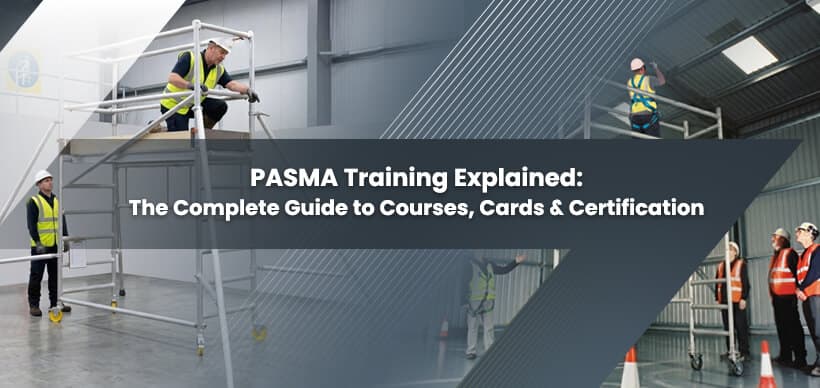
What Is PASMA Training?
If you work with mobile access towers, podiums or other forms of low-level access equipment, you may have come across PASMA training.
But what does PASMA actually mean, what does a PASMA course involve, and which qualification do you need?
PASMA is the Prefabricated Access Suppliers’ and Manufacturers’ Association. Founded in 1974, PASMA is recognised as an authority for mobile access towers and provides an industry-standard training scheme covering different types of tower and access equipment.
In simple terms, PASMA training helps people understand how to select, assemble, alter, move, inspect and use relevant access equipment safely.
It is not one single course for everyone. PASMA has different courses for different equipment and responsibilities. The correct course depends on what you will be using and whether you are a user, manager or specialist.
This guide explains:
● what PASMA means;
● what PASMA training is;
● the main PASMA courses;
● how PASMA qualifications and cards work;
● what is covered during training;
● how long qualifications last;
● PASMA training costs;
● online and onsite options;
● PASMA and IPAF differences;
● and how to choose the right training.
What Does PASMA Stand For?
PASMA stands for Prefabricated Access Suppliers’ and Manufacturers’ Association.
The organisation focuses on the safe use of mobile access towers and related access equipment. It also develops and governs an industry-standard training scheme for mobile access towers.
This is why the term PASMA scaffolding is often used when people search for training relating to mobile scaffold towers.
However, PASMA is not simply another word for scaffolding. The training is focused on specific access equipment and the competence required to use it safely.
PASMA meaning in simple terms:
PASMA | Prefabricated Access Suppliers’ and Manufacturers’ Association
PASMA Training | Training for safe use of relevant access towers and equipment
PASMA Course | A specific training course covering a defined equipment type or responsibility
PASMA Qualification | Evidence that the delegate has successfully completed the relevant training
The important point is that PASMA training is category-specific. Completing one course does not automatically mean that someone is trained for every type of tower.
PASMA itself explains that users should take the courses covering the towers they intend to use.
What Is PASMA Training?
PASMA training is practical and theoretical training designed to develop competence when working with mobile access towers and related equipment.
The exact content depends on the course.
For example, a standard user course can cover:
● tower components;
● safe assembly;
● dismantling;
● alteration;
● movement;
● inspection;
● safe access;
● workplace hazards;
● relevant standards;
● safe working practices.
The training is intended to give workers more than basic instructions. It helps them understand why particular methods are required and how to recognise unsafe conditions.
This is important because tower safety does not depend only on the physical equipment. The user also needs to understand the limitations of the tower, the manufacturer's instructions, the working environment and the risks associated with the task.
HSE guidance states that people working at height need sufficient skills, knowledge and experience, with training appropriate to the work being undertaken.
Who Needs PASMA Training?
PASMA training can be relevant to anyone who uses or manages mobile access towers or applicable low-level access equipment.
Typical users include:
● construction workers;
● maintenance teams;
● facilities teams;
● electricians;
● decorators;
● installers;
● shopfitters;
● contractors;
● event workers;
● industrial maintenance workers.
It can also be relevant to supervisors and managers who are responsible for people using tower equipment.
The important question is not simply “Do I work at height?”
Instead, ask:
What equipment will I use, and what responsibility do I have for it?
Someone physically assembling and using a tower may need a user-level qualification, while someone responsible for supervising tower users may need manager-focused training.
PASMA Course Types Explained
There is no single universal PASMA course that covers every situation.
The main training routes include standard tower-user training, low-level access training, combined training and courses for managers. There are also specialist courses for particular tower configurations.
Main PASMA training options:
Towers for Users | Mobile access towers | 1 day | Yes
Low-Level Access | Low-level platforms | Half day | Yes
Combined | Towers + low-level access | 1 day | Yes
Towers for Managers | Management and supervision | 1 day | No practical
Specialist courses | Specific tower configurations | Usually 1 day | Yes
PASMA confirms that course duration, assessment and qualification details vary by course.
For a more detailed comparison of the available options, see our guide to PASMA Course Types: Which One Do You Need?.
PASMA Towers for Users
PASMA Towers for Users is the standard route for people who need to use mobile access towers.
The course is designed for both new users and people who have previously used towers without formal training.
PASMA states that the course lasts one day and includes practical training. It covers the safe assembly, dismantling, alteration, movement and use of mobile access towers, together with inspection and hazard awareness.
The course includes theory and practical assessment.
The theory assessment has an 80% pass mark, followed by practical assessment. Successful delegates receive a PASMA PhotoCard and Certificate.
This is generally the starting point for people who regularly need to assemble and use standard mobile access towers.
PASMA Low-Level Access Training
Not every task requires a full mobile access tower.
Low-level access equipment such as podiums and similar platforms has its own training route.
The PASMA Low-Level Access course is designed for people using low-level work platforms under 2.5 metres. PASMA lists the course as a half-day programme with both theory and practical assessment.
Training covers areas such as:
● equipment components;
● assembly and dismantling;
● safe use;
● inspection;
● movement;
● workplace hazards;
● relevant standards;
● safe access.
This distinction matters because completing a tower-user course does not mean every type of low-level access equipment is automatically covered.
PASMA Combined Course
If your work involves both mobile access towers and low-level access equipment, a PASMA Combined Course may be the more suitable option.
The combined programme covers the content of both Towers for Users and Low-Level Access in one training day.
PASMA states that the combined course covers EN 1004 and BS 8620 and includes both theory and practical assessment. Successful candidates receive both qualifications.
This can be useful for workers whose daily tasks change between standard mobile towers and low-level access platforms.
For a detailed explanation of the course options, see PASMA Course Types Explained.
PASMA Training for Managers
Not everyone who needs PASMA knowledge will physically assemble a tower.
Site managers, supervisors and other responsible people may need to understand how tower work should be planned, organised and controlled.
PASMA Towers for Managers is designed for people who manage or supervise tower users rather than operate the equipment themselves.
PASMA lists this as a one-day course with an open-book theory assessment and an 80% pass mark. Successful delegates receive a PhotoCard and Certificate showing the manager level.
This distinction helps employers choose training according to the person's actual role rather than simply putting every worker through the same course.
Specialist PASMA Tower Categories
Standard tower training does not automatically cover every unusual tower arrangement.
PASMA has additional categories for specialist configurations, including:
● A5 – Towers on Stairways
● A6 – Towers with Cantilevers
● A7 – Towers with Bridges
● A8 – Linked Towers
● A9 – Large Deck Towers
PASMA also identifies different card levels, including U for User, I for Instructor and M for Manager, with specialist statuses also available.
This is one reason checking the category shown on a PASMA card is important. The card indicates which training has actually been completed.
If your work involves an unusual tower configuration, do not assume that standard tower training automatically covers it.
What Does a PASMA Course Cover?
Although the syllabus varies between courses, PASMA training normally combines knowledge with practical application.
Common subjects can include:
Equipment knowledge
Delegates learn about tower components and the purpose of different parts.
Assembly and dismantling
The course explains how equipment should be assembled and dismantled using approved methods.
Safe movement
Workers learn when equipment can be moved and what precautions need to be taken.
Inspection
Training helps users recognise the importance of pre-use checks and inspections.
Workplace hazards
The surrounding environment can affect tower safety. Workers need to recognise risks such as uneven surfaces, obstructions and other site hazards.
Safe access
Training covers how users should access the working platform safely.
Regulations and standards
The course introduces relevant standards, legislation and guidance that affect tower use.
The combined course, for example, specifically includes pre-use checks, post-assembly inspections, workplace hazards and safe movement.
PASMA and Working at Height
Mobile towers are a form of equipment used for working at height, so tower users need to understand the wider safety requirements surrounding work at height.
HSE guidance states that work at height should be properly planned and carried out by people with suitable competence. The level of competence depends on the task and equipment involved.
For tower work, this means looking beyond the PASMA card itself.
A safe system should also consider:
● the task being performed;
● the equipment selected;
● ground conditions;
● access and egress;
● weather;
● surrounding hazards;
● manufacturer's instructions;
● inspection requirements;
● the competence of the people involved.
A qualification supports competence, but it does not replace site-specific risk assessment, planning or following the equipment manufacturer's instructions.
For a deeper explanation of this subject, read PASMA Working at Height Training: Course Content & Legal Requirements.
PASMA Card, Certificate and Qualification
One of the most common questions is whether a PASMA card and PASMA certificate are the same thing.
They are related, but they serve different purposes.
After successful completion of relevant PASMA training, delegates can receive a PASMA PhotoCard and Certificate. The card provides a convenient way to show the person's training level and categories.
The category is particularly important because it indicates the type of course completed.
For example:
Card information | What it indicates
U | User level
M | Manager level
I | Instructor level
T | Towers for Users
L | Low-Level Access
A5 | Towers on Stairways
A6 | Towers with Cantilevers
A7 | Towers with Bridges
A8 | Linked Towers
A9 | Large Deck Towers
These levels and categories are defined by PASMA.
For more information about obtaining and checking your ticket, see PASMA Card & Certificate: Get, Check & Renew.
How Long Does PASMA Qualification Last?
For many standard PASMA courses, the qualification period is five years, although PASMA notes that this can vary regionally.
For example, PASMA currently lists five years for Towers for Users, Low-Level Access, Combined and Towers for Managers.
Workers should not simply assume their card remains valid indefinitely.
Before starting work, employers and workers should check:
1. which qualification they hold;
2. which category is shown;
3. when it expires;
4. whether the equipment they are using is covered;
5. whether refresher or additional training is required.
A card may prove that someone completed training, but the category still needs to match the equipment and task.
PASMA Training Cost: What Affects the Price?
There is no single fixed PASMA training cost for every course and location.
The PASMA course price can vary depending on:
● course type;
● training location;
● course duration;
● onsite or centre-based delivery;
● number of delegates;
● specialist equipment requirements;
● refresher or additional categories.
For this reason, asking “how much is a PASMA course?”
The same applies to PASMA course cost. A half-day low-level access course will naturally have different pricing from a one-day combined or specialist programme.
The length of training also differs. Towers for Users is one day, Low-Level Access is half a day, while Combined is one day.
For a detailed pricing discussion, see PASMA Training Cost: 2026 Price Guide.
Online PASMA Training vs Onsite Training
People often search for PASMA training online, online PASMA training or PASMA course online because online learning can be convenient.
However, the availability of online learning depends on the course and training provider.
For example, PASMA currently states that e-learning is available for the theory segment of Towers for Users and Low-Level Access, while practical assessment remains part of the relevant qualification.
This means online learning should not automatically be confused with completing an entire practical qualification remotely.
Centre-based training
A training centre can provide:
● instructor-led theory;
● practical equipment;
● controlled assessment conditions;
● hands-on experience.
Onsite PASMA training
Onsite delivery can be useful when several employees need training or when the employer wants training delivered around its working environment.
The availability of onsite training depends on the course, provider and site requirements.
A PASMA course weekend may also be available from some providers, but availability should always be checked before planning around a specific date.
For a full comparison, read Online & Onsite PASMA Training Options.
PASMA vs IPAF: Do You Need Both?
IPAF and PASMA are not the same qualification.
PASMA focuses mainly on mobile access towers and related access equipment.
IPAF training is associated with powered access equipment such as mobile elevating work platforms.
The correct qualification therefore depends on the equipment being used.
For example:
Equipment | Relevant training area
Mobile access tower | PASMA
Low-level access equipment | PASMA Low-Level Access
Scissor lift | Usually IPAF
Mobile boom | Usually IPAF
Articulated boom | Usually IPAF
Telescopic boom | Usually IPAF
A worker who uses both towers and powered access equipment may need both forms of training.
That does not mean an IPAF and PASMA combined course is one universal qualification. They remain separate competency areas even where a provider offers both as part of a wider training package.
Read our dedicated comparison at IPAF vs PASMA: Key Differences Explained.
Scaffold Tower Equipment: Training Is Only One Part
Having the right scaffold tower equipment is just as important as having appropriately trained users.
Equipment should be suitable for the intended task and used according to the manufacturer's instructions.
Before using a tower, workers should understand:
● what type of tower it is;
● its intended configuration;
● how it should be assembled;
● how it should be inspected;
● how it should be moved;
● its operating limitations;
● and when it should not be used.
Employers should also make sure equipment is maintained and suitable for the working environment.
People searching for scaffolding manufacturers near me, HSS scaffold tower, HSS PASMA training, HSS PASMA course or PASMA scaffold near me should still check the actual equipment, training category and provider rather than choosing solely because of a supplier's name.
For practical guidance on choosing, buying or hiring equipment, see Scaffold Tower Equipment: Buying vs Hiring Guide.
How to Choose the Right PASMA Course
The easiest way to choose is to start with the equipment and your role.
Step 1: Identify the equipment
Are you using:
● mobile access towers?
● low-level access equipment?
● both?
● a specialist tower configuration?
Step 2: Identify your responsibility
Are you:
● physically using and assembling the equipment?
● supervising other users?
● managing tower work?
● working towards specialist competence?
Step 3: Check the required category
Do not book a course simply because it contains the word PASMA.
Check what equipment and configuration the course actually covers.
Step 4: Check the practical element
If your job involves physically assembling or using equipment, practical training is particularly important.
Step 5: Check your existing card
If you already have PASMA training, check your current card and category before booking another course.
This prevents workers from taking unsuitable training or assuming that one qualification covers equipment outside its scope.
PASMA Training Near Me: Finding the Right Course
Searches such as PASMA training near me are useful when you are trying to find a convenient course, but location should not be the only factor.
When comparing providers, check:
● whether the provider is PASMA approved;
● which course is offered;
● the qualification category;
● course duration;
● practical assessment;
● available dates;
● onsite options;
● and total price.
If you are searching for a specific region, you may also come across terms such as PASMA training London, PASMA course Birmingham or PASMA courses Manchester.
The same principle applies regardless of location: choose the course based on the equipment and responsibility first, then compare availability and convenience.
For a location-focused guide, see PASMA Training Near You | Find a Course by Location.
Why PASMA Training Matters for Employers
For employers, PASMA training can help demonstrate that workers have received structured training relevant to mobile access tower use.
However, training should form part of a wider safety system.
Employers should also consider:
● risk assessments;
● method statements where appropriate;
● equipment inspections;
● manufacturer's instructions;
● supervision;
● site conditions;
● worker competence;
● emergency arrangements.
HSE guidance makes clear that work at height needs appropriate planning, equipment selection and competent people.
The strongest approach is therefore not simply:
“Everyone has a card.”
It is:
The right person has the right training for the right equipment, and the work is properly planned and controlled.
PASMA Training with AFI Training
AFI Training provides accredited working-at-height training for organisations and individuals across the UK.
For anyone comparing PASMA options, the key is to select training based on the actual equipment and responsibilities involved rather than choosing a course based only on its name or price.
Whether the requirement is standard tower-user training, low-level access, combined training or another relevant category, the course should match the work being carried out.
PASMA Training FAQs
1. What does PASMA stand for?
PASMA stands for Prefabricated Access Suppliers’ and Manufacturers’ Association. It is an organisation focused on mobile access towers, safety, standards and training.
2. What is PASMA training?
PASMA training develops the knowledge and practical skills needed to use relevant mobile access towers and access equipment safely.
3. What is a PASMA course?
A PASMA course is a specific training programme covering a particular type of equipment or responsibility. Different courses cover towers, low-level access, management and specialist tower configurations.
4. Is PASMA a qualification?
Yes. Successful completion of an appropriate PASMA course results in a PASMA PhotoCard and Certificate for the relevant training category.
5. How long is a PASMA qualification valid?
Many standard PASMA qualifications are listed as valid for five years, although PASMA states that this may vary regionally.
6. How long is a PASMA course?
It depends on the course. Towers for Users is one day, while Low-Level Access is half a day. The Combined course is one day.
7. How much is a PASMA course?
The price depends on the course, location, delivery method, number of delegates and other requirements. There is no single PASMA course cost for every situation.
8. Can PASMA training be completed online?
Some PASMA courses provide e-learning for the theory element. However, relevant practical assessment remains important, so online theory should not automatically be treated as a complete practical qualification.
9. Can I take a PASMA course online?
Online theory may be available depending on the course and provider. Check exactly what is included before booking a PASMA course online.
10. Do I need PASMA training to use a scaffold tower?
People using mobile access towers need appropriate competence for the work. PASMA training is an established industry training route for mobile access tower users, while the exact requirement should be considered alongside the equipment, task and employer's arrangements.
11. What is the difference between PASMA and IPAF?
PASMA primarily covers mobile access towers and related equipment, while IPAF training is generally associated with powered access such as MEWPs. The correct training depends on the equipment you operate.
12. Can I use my PASMA card for every type of tower?
No. Your PASMA card shows the categories you have completed. Specialist tower types can require additional training.
13. What is the PASMA Towers for Users course?
It is a one-day course for people who need to assemble, dismantle, alter, move and use relevant mobile access towers. It includes theory and practical assessment.
14. What is PASMA Low-Level Access training?
It is a half-day course for people using low-level access equipment, including platforms used for work below 2.5 metres. It includes theory and practical assessment.
15. Is there a PASMA combined course?
Yes. The PASMA Combined Low-Level Access and Towers for Users course combines both areas into one day and covers the relevant EN 1004 and BS 8620 standards.
16. Is PASMA training available in London?
Yes, PASMA training may be available through approved providers in London. When searching for PASMA training London, check the exact course category and provider approval rather than choosing solely on location.
17. Can I find a PASMA course in Birmingham?
Yes, courses may be available in Birmingham and surrounding areas. When searching for a PASMA course in Birmingham, compare the course type, dates, practical training and provider details.
18. Are PASMA courses available in Manchester?
PASMA courses may be available in Manchester and the surrounding region. A search for PASMA courses Manchester should be followed by checking the exact qualification and training format.
19. How can I find PASMA training near me?
Use your location to identify nearby approved training providers, then check whether the course covers the equipment you need to use. The nearest course is not necessarily the correct course.
20. How do I check my PASMA card?
Check the card details, including your training level and categories, and use the relevant official verification route where required. Your category is important because it shows which courses you have completed.
Conclusion
PASMA training helps workers develop the knowledge and practical skills needed to use relevant access towers safely. The right course depends on the equipment, tower configuration and level of responsibility involved.
From Towers for Users and Low-Level Access to Combined, Manager and specialist courses, choosing the correct PASMA qualification is important for maintaining competence at work.
A PASMA card records the training categories completed, so employers and workers should always check that the qualification matches the equipment and tasks involved.
For safe working at height, training should also be supported by proper planning, suitable equipment, inspections, manufacturer guidance and competent supervision.
AFI Training can help businesses and individuals understand which PASMA training route is appropriate for their work and requirements.