
PASMA Card & Certificate: How to Get, Check & Renew Your PASMA Ticket
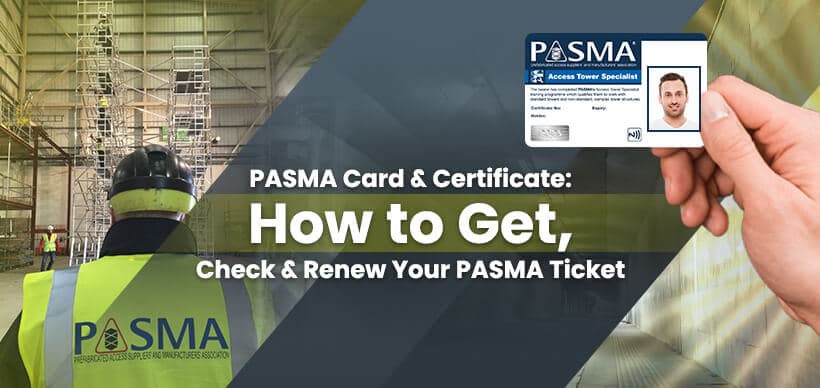
If you have completed PASMA training, one of the most important things to understand is what your PASMA card and certificate actually prove.
Many workers simply refer to it as a PASMA ticket, PASMA cert or PASMA qualification, but these terms can refer to different parts of the same training record.
Your PASMA PhotoCard provides a convenient way of showing the training you have completed, while your certificate provides additional evidence of successful completion. The category shown on the card is particularly important because PASMA training is divided into different levels and equipment categories.
This guide explains how the PASMA card works, what the certificate means, how to check your training record, how long qualifications last and what to do when your qualification needs renewing.
For a wider explanation of PASMA training, course types and qualification requirements, see the complete PASMA Training Guide.
What Is a PASMA Card?
A PASMA card is a PhotoCard issued to successful candidates after completing relevant PASMA training.
It provides evidence of the training categories and level that the holder has achieved.
The card is useful because an employer, site manager or other responsible person can use it to understand what type of PASMA training a worker has completed.
However, having a PASMA card does not automatically mean that a person is trained for every type of tower.
The category shown on the card matters.
For example, a worker trained for standard Towers for Users should not automatically assume that their card covers specialist tower configurations.
PASMA explains that its card categories identify the courses completed and the types of tower the person has been trained to assemble.
What Is a PASMA Certificate?
A PASMA certificate is provided to successful candidates alongside the PhotoCard for the relevant qualification.
The certificate gives a formal record of the training completed.
It can be useful for:
● employer records;
● training records;
● site compliance checks;
● demonstrating competence;
● confirming the course completed.
The card is convenient for day-to-day identification, while the certificate provides supporting documentation.
Workers should keep both documents safe and make sure their employer has access to the relevant training information where required.
What Is a PASMA Ticket?
The phrase PASMA ticket is commonly used in the construction and access industry to describe evidence of PASMA training.
It usually refers to the PASMA PhotoCard or the qualification represented by it.
You may therefore hear people ask:
● “Have you got your PASMA ticket?”
● “Is your PASMA card still valid?”
● “When does your PASMA cert expire?”
● “Can you check your PASMA qualification?”
These questions generally relate to the same underlying training record.
However, it is still important to check the actual card and qualification rather than relying on the word “ticket”.
What Information Does a PASMA Card Show?
A PASMA card identifies the holder and the training categories they have completed.
The categories are important because they indicate the scope of the person's training.
PASMA identifies several competence levels and categories, including:
Code | Meaning
U | User
M | Manager
I | Instructor
T | Towers for Users
L | Low-Level Access
W | Work at Height – Novice
A5 | Towers on Stairways
A6 | Towers with Cantilevers
A7 | Towers with Bridges
A8 | Linked Towers
A9 | Large Deck Towers
PASMA's competence guidance explains the different card levels and course categories.
This is why an employer should check more than whether someone simply has a PASMA card.
The specific category should be appropriate for the work being undertaken.
PASMA Card Categories Explained
T – Towers for Users
The T category relates to Towers for Users training.
It is intended for people who need competence in using relevant standard mobile access towers.
This can include assembly, dismantling, alteration, movement, inspection and safe use.
L – Low-Level Access
The L category relates to Low-Level Access training.
This applies to the relevant low-level access equipment covered by the course.
W – Work at Height – Novice
The W category relates to PASMA's Work at Height – Novice training.
This is different from the standard tower-user category and should not be confused with full tower assembly training.
A5 – Towers on Stairways
A5 relates to training for relevant tower configurations used on stairways.
A6 – Towers with Cantilevers
A6 covers the relevant cantilever tower configuration.
A7 – Towers with Bridges
A7 identifies Towers with Bridges training.
A8 – Linked Towers
A8 identifies Linked Towers training.
A9 – Large Deck Towers
A9 identifies Large Deck Towers training.
These specialist categories are important because different tower configurations can present different requirements.
Why Your PASMA Category Matters
One of the biggest mistakes is treating a PASMA card as a general permission to use every type of tower.
It is better to think of the card as a record of specific competence.
For example:
A worker with standard Towers for Users training should check whether additional training is needed before working with a specialist tower configuration.
This is especially important when workers move between different projects.
A construction company might use standard mobile towers on one project but require stairway or cantilever configurations on another.
The employer should therefore compare the equipment being used with the categories shown on the worker's PASMA card.
How Do You Get a PASMA Card?
The normal route to obtaining a PASMA card is to complete the relevant PASMA training course successfully.
The exact course depends on your job and the equipment you need to use.
For example:
● standard mobile towers → Towers for Users;
● low-level access → Low-Level Access;
● both → Combined;
● management responsibilities → Towers for Managers;
● specialist tower configurations → relevant specialist course.
Once the required training and assessments have been successfully completed, the appropriate PASMA PhotoCard and Certificate are issued.
PASMA states that successful candidates on its Towers for Users course receive a PhotoCard and Certificate.
What Happens During PASMA Assessment?
The assessment depends on the course.
For user-focused courses, the process generally includes both theory and practical elements.
For example, PASMA's Towers for Users course includes a theory assessment followed by a practical assessment. The theory assessment currently has an 80% pass mark.
The purpose is to establish that the candidate understands the relevant knowledge and can apply it in practice.
This is important because tower competence is not only about remembering information.
A worker may need to demonstrate that they can apply safe procedures to the equipment covered by their training.
How Long Is a PASMA Card Valid?
Many standard PASMA qualifications are currently listed as valid for five years, although PASMA notes that qualification periods may vary regionally.
For example, PASMA lists a five-year qualification period for Towers for Users, Low-Level Access and Combined courses.
This means workers should check the relevant expiry information rather than assuming their card remains valid indefinitely.
Keep track of your expiry date.
It is good practice to review your PASMA qualification before it reaches its expiry date.
This gives you time to:
1. confirm the current qualification;
2. identify any additional training required;
3. arrange the next course;
4. update employer records;
5. avoid problems when attending a site.
How to Check a PASMA Card
If you need to check a PASMA card, start by reviewing the details shown on the card.
Check:
● the holder's details;
● training level;
● training categories;
● qualification information;
● expiry or validity information where shown.
You should also use the appropriate official verification process where an employer or site requires confirmation.
The key point is to check the actual training category, not just whether the person possesses a card.
For example, someone may hold PASMA training but not have the specialist category required for a particular tower arrangement.
PASMA Card Checker: What Should Employers Look For?
A PASMA card checker process should help employers confirm that the worker's qualification matches the work.
Before allowing tower work to begin, employers can consider:
1. Is the card genuine and current?
The qualification should be verified through the appropriate official process where required.
2. Is the qualification still valid?
Check the relevant validity or expiry information.
3. Does the category match the equipment?
This is particularly important.
4. Is the worker's role covered?
A manager qualification and a practical user qualification are not necessarily interchangeable.
5. Does the site require additional competence?
Specialist configurations may require additional training.
This approach provides a more useful check than simply asking, “Have you got a PASMA card?”
What If Your PASMA Card Has Expired?
If your PASMA ticket has expired, do not simply continue treating it as current.
Instead, check the appropriate training route with a PASMA-approved training provider.
The correct option can depend on:
● the original qualification;
● the date it expired;
● the category required;
● current training arrangements;
● the equipment you now use.
If your job has changed since your original course, this is also a good opportunity to check whether you now need an additional category.
PASMA Renewal: When Should You Renew?
It is sensible to start thinking about renewal before your qualification expires.
Waiting until the final few days can create unnecessary pressure, particularly if training dates are limited.
A simple approach is:
Check → Confirm → Book → Complete → Update records
First, check the current card.
Then confirm which qualification you need.
After that, arrange the appropriate training and update your employer's records once completed.
The exact renewal route should always be confirmed with the relevant training provider because training requirements and course arrangements can change.
Is PASMA Renewal the Same as Taking the Original Course?
Not necessarily.
The correct training route depends on the qualification you hold and its status.
If your card is approaching expiry, speak to an approved provider about the current requirements rather than assuming that the original course format will always be identical.
This is particularly important if:
● your responsibilities have changed;
● you now use different tower configurations;
● your original qualification has expired for some time;
What If You Lose Your PASMA Card?
Losing the physical card does not necessarily mean that your training history has disappeared.
If you lose your PASMA card, contact the appropriate PASMA channel or training provider to find out how your training record can be checked and what replacement options are available.
It is also useful for employers to retain copies of relevant training documentation as part of their competence records.
Do not simply book another course because you have misplaced a card without first checking whether your existing qualification can be verified.
What If You Lose Your PASMA Certificate?
The same principle applies to a lost PASMA certificate.
If the certificate is missing, check whether the training record can be confirmed through the appropriate provider or PASMA process.
Keeping digital copies of training certificates can also make record management easier for businesses.
SMA Card vs PASMA Certificate
Although they relate to the same training, the card and certificate have different practical uses.
PASMA Card | PASMA Certificate
Photo identification | Formal training record
Easy to carry | Useful for employer records
Shows training categories | Records successful course completion
Useful for site checks | Useful for documentation
Convenient day-to-day evidence | Supporting evidence of qualification
Both should be retained where possible.
Does Every PASMA Card Cover the Same Training?
No. This is one of the most important things to understand.
PASMA training is divided into different categories, so two people can both hold PASMA cards while having different training records.
For example:
● Worker A: Towers for Users
● Worker B: Low-Level Access
● Worker C: Towers for Users + Low-Level Access
● Worker D: Towers for Users + specialist category
They all have PASMA training, but their competence is not identical.
This is why employers should check the category rather than relying on the name “PASMA”.
Can You Add More PASMA Categories Later?
Yes, where additional training is required.
A worker's responsibilities may change during their career.
Someone may initially work only with standard towers and later become responsible for specialist configurations.
In that situation, the existing training should be reviewed and additional relevant training completed where necessary.
The aim is to ensure the card accurately represents the worker's current competence.
PASMA Card and Specialist Tower Work
Specialist tower configurations deserve particular attention.
PASMA identifies separate categories for:
● Towers on Stairways;
● Towers with Cantilevers;
● Towers with Bridges;
● Linked Towers;
● Large Deck Towers.
These categories exist because the configurations are different from ordinary tower arrangements.
If your work involves one of these systems, check your card before starting.
For more information about tower-user training and what the practical course covers, see Tower Scaffold Training: What's Covered & Why It's Required.
PASMA Card for Employers
Employers can use PASMA cards as part of their wider competence-management process.
However, a card should not be treated as the only safety check.
Employers should also consider:
● the equipment being used;
● manufacturer's instructions;
● risk assessment;
● site conditions;
● supervision;
● inspection arrangements;
● the worker's experience;
● any additional site-specific requirements.
HSE guidance states that work at height should be properly planned and carried out by competent people, with training appropriate to the work involved.
The PASMA card is therefore best viewed as one part of a wider competence system.
PASMA Card and Site Access
Some construction and industrial sites may ask workers to provide evidence of relevant training before they are permitted to carry out particular tasks.
Having your PASMA card available can make it easier to demonstrate your training status.
However, site rules can vary.
A site may require additional evidence, induction or task-specific competence beyond the PASMA qualification.
Workers should therefore check the requirements before arriving on site.
Does a PASMA Card Mean You Can Use Any Scaffold Tower?
No. A PASMA card does not mean that every tower configuration is automatically covered.
The training category should match the equipment and work involved.
For example, a worker with standard tower-user training should check whether additional competence is required for a specialist configuration.
The same principle applies when moving between different access systems.
PASMA Qualification vs General Work-at-Height Training
PASMA training and general work-at-height training are not necessarily the same thing.
PASMA courses focus on relevant access towers and equipment.
General work-at-height training can cover broader subjects such as:
● planning;
● risk control;
● equipment selection;
● fall prevention;
● work-at-height responsibilities.
A worker may therefore need more than one type of training depending on their role.
Employers should assess the full requirements of the job rather than assuming one certificate covers every work-at-height activity.
If you are unsure which PASMA course is right for your role, see our guide to PASMA course types, including Towers for Users, Low Level Access and Combined training.
PASMA Card Renewal Checklist
Before your PASMA qualification expires, use this simple checklist:
● Check your current card
Confirm the qualification and categories you hold.
● Check the expiry date
Do not wait until your card has already expired.
● Review your current job
Ask whether your equipment or responsibilities have changed.
● Identify additional categories
You may need specialist training if your work has expanded.
● Contact an approved provider
Confirm the correct current training route.
● Complete the required assessment
Make sure the relevant theory and practical requirements are completed.
● Update employer records
Keep your training information current.
How AFI Training Can Help
AFI Training provides PASMA training for workers and businesses across the UK.
When choosing a PASMA course, the most important consideration is whether the training matches your actual equipment and responsibilities.
If you already have a PASMA card, review the categories before booking another course. This can help identify whether you need renewal, additional training or a different qualification.
PASMA Card & Certificate FAQs
What is a PASMA card?
A PASMA card is a PhotoCard issued to successful candidates showing the relevant training level and categories they have completed.
What is a PASMA certificate?
A PASMA certificate provides formal evidence of successful completion of the relevant PASMA training.
What is a PASMA ticket?
“PASMA ticket” is a common informal term for evidence of PASMA training, usually referring to the PASMA PhotoCard or qualification.
How do I get a PASMA card?
You normally receive the relevant PASMA PhotoCard after completing the required PASMA course and assessments.
How long is a PASMA card valid?
Many standard PASMA qualifications are currently listed as valid for five years, although this can vary regionally.
How do I check my PASMA card?
Check the card details and categories, then use the appropriate official verification route where confirmation is required.
What does the T on my PASMA card mean?
The T category relates to Towers for Users training.
What does L mean on a PASMA card?
L identifies Low-Level Access training.
What does A5 mean on a PASMA card?
A5 identifies training for Towers on Stairways.
What does A6 mean on a PASMA card?
A6 identifies Towers with Cantilevers.
What does A7 mean on a PASMA card?
A7 identifies Towers with Bridges.
What does A8 mean on a PASMA card?
A8 identifies Linked Towers.
What does A9 mean on a PASMA card?
A9 identifies Large Deck Towers.
Can I renew my PASMA card after it expires?
You should contact an approved training provider to confirm the correct current training route based on your qualification and circumstances.
What happens if I lose my PASMA card?
Contact the relevant training provider or PASMA to find out how your training record can be verified and whether a replacement can be issued.
Do I need my PASMA certificate as well as my card?
It is advisable to retain both. The card is convenient for identification, while the certificate provides supporting training documentation.
Can I use my PASMA card for specialist towers?
Only if the relevant training category covers the specialist tower configuration. Check your card before carrying out specialist tower work.
Can I check PASMA training online?
Online verification options may be available through the appropriate official PASMA systems. Use the current official verification process rather than relying on an unofficial checker.
Is PASMA training available in London?
Yes, PASMA courses may be available through approved providers in London. When searching for PASMA training London, check the exact category and course type required.
Can I get a PASMA course in Birmingham?
PASMA training may be available in Birmingham and surrounding areas. When looking for a PASMA course in Birmingham, compare the qualification, course content and available dates.
Are PASMA courses available in Manchester?
PASMA courses may be available in Manchester and surrounding areas. If searching for PASMA courses in Manchester, make sure the course matches your equipment.
How can I find PASMA training near me?
Search for an approved provider in your area, then confirm that the course covers the equipment and category you need. The nearest course is not always the right course.
Conclusion
A PASMA card is more than proof that someone has attended a training course. The categories shown on the card identify the type and level of PASMA training completed.
Understanding the difference between your PASMA card, PASMA certificate and PASMA ticket can help workers keep their records up to date and help employers check that training matches the work being carried out.
Before using a tower, always check the relevant qualification category, validity and any additional competence requirements.
If your card is approaching expiry, do not leave renewal until the last minute. Review your current role, identify the training you need and confirm the correct route with an approved training provider.