
PASMA Course Types Explained: Towers for Users, Low-Level Access & Combined
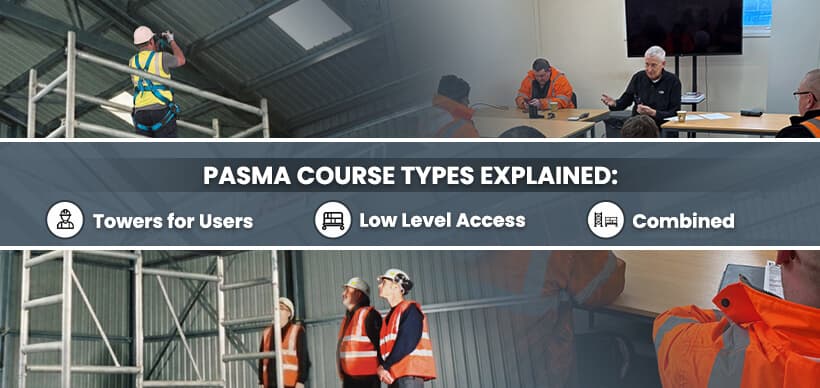
If you are looking for PASMA training, choosing the right course is just as important as finding an approved training provider. PASMA offers several course types, and each one is designed around a particular type of access equipment, tower configuration or level of responsibility.
A worker who uses a standard mobile access tower may need a different course from someone who works with low-level access equipment. A supervisor may need management training, while a person working with towers on stairs or cantilever configurations may require specialist training.
For a wider introduction to PASMA, its meaning, qualifications, cards, costs and training requirements, read our complete PASMA Training Guide.
This guide focuses specifically on the different PASMA course types, what they cover, who they are for and how to decide which option fits your work.
What PASMA Course Types Are Available?
PASMA provides training for different access systems and responsibilities rather than offering one course that covers every situation.
The main options include standard tower-user training, low-level access, combined training, management training and specialist courses.
PASMA Course | Main Purpose | Typical Duration | Practical Assessment
Towers for Users | Standard mobile access towers | 1 day | Yes
Low-Level Access | Low-level access equipment | Half day | Yes
Combined Towers & Low-Level Access | Both equipment types | 1 day | Yes
Towers for Managers | Management and supervision | 1 day | No
Towers on Stairways | Specialist tower use on stairs | 1 day | Yes
Towers with Cantilevers | Cantilever tower configurations | Specialist | Yes
Towers with Bridges | Bridge configurations | Specialist | Yes
Linked Towers | Linked tower configurations | Specialist | Yes
Large Deck Towers | Large deck configurations | Specialist | Yes
PASMA states that users should take courses covering the towers they intend to use. This is why selecting a course based on the actual equipment and working situation is important.
1. PASMA Towers for Users
PASMA Towers for Users is the main course for people who need to assemble, dismantle, alter, move, inspect and use standard mobile access towers.
It is suitable for both new and existing users. You do not necessarily need previous tower experience before attending the course.
PASMA currently lists the course as a one-day programme with theory and practical assessment. The maximum class size is 12, and the qualification is generally valid for five years, subject to regional arrangements.
Who is Towers for Users training for?
This course can be suitable for people working in:
● construction;
● property maintenance;
● facilities management;
● electrical installation;
● decorating;
● mechanical installation;
● shopfitting;
● general building work;
● industrial maintenance.
It is particularly relevant when the worker is expected to physically work with a mobile access tower rather than simply supervise someone else using one.
What does the course cover?
The training addresses the practical and theoretical knowledge required for safe tower use.
Typical areas include:
● tower components;
● assembly procedures;
● dismantling;
● alteration;
● movement;
● inspection;
● safe access;
● workplace hazards;
● relevant standards;
● safe working practices.
The theory assessment currently has an 80% pass mark, followed by practical assessment. Successful delegates receive a PASMA PhotoCard and Certificate.
When should you choose this course?
Choose Towers for Users when your normal work involves standard mobile access towers, and you need user-level competence for those towers.
If you only use low-level access equipment, another course may be more appropriate.
2. PASMA Low-Level Access Training
Not every job requires a conventional mobile access tower.
Some workers use low-level platforms and similar access systems for tasks where a full tower is not necessary. PASMA provides dedicated Low-Level Access training for this type of equipment.
The course is currently listed as a half-day programme with both theory and practical assessment. It is designed around low-level access platforms below 2.5 metres.
Who should consider Low-Level Access training?
This option can be appropriate for workers who regularly use:
● low-level work platforms;
● podium-style access equipment;
● applicable low-level access systems.
The course is particularly useful when low-level access forms a normal part of the worker's job.
What is covered?
The course can cover:
● identifying equipment components;
● assembly;
● dismantling;
● movement;
● inspection;
● safe access;
● workplace hazards;
● applicable standards;
● safe working practices.
The theory assessment has an 80% pass mark, alongside the practical assessment.
Is Low-Level Access the same as Towers for Users?
No. Although both courses relate to access equipment, they address different equipment types.
A worker should therefore not assume that completing one course automatically means they are trained for every type of access platform.
3. PASMA Combined Course
Some workers use both standard mobile towers and low-level access equipment.
For these situations, the PASMA Combined Towers and Low-Level Access course can be a practical option.
The course combines both areas into a single training programme. PASMA currently lists it as a one-day course covering EN 1004 and BS 8620, with theory and practical assessment.
Who is the Combined course suitable for?
It can be useful for workers whose duties change between different access systems.
For example, a maintenance worker may use:
● a mobile access tower for overhead maintenance;
● a low-level platform for shorter tasks;
● different access equipment depending on the work area.
Instead of completing the two user courses separately, the combined programme covers both relevant areas.
Current course details
Feature | Combined Course
Duration | 1 day
Theory | Yes
Practical | Yes
Maximum delegates | 8
Previous experience | Not required
Qualification period | Generally 5 years
Equipment areas | Towers + low-level access
PASMA currently states that successful delegates receive both qualifications.
When is Combined better than taking two separate courses?
The Combined course may be preferable when both equipment types are part of the worker's normal duties.
It can reduce the need to schedule two separate training sessions while giving the worker training in both relevant areas.
However, it should still be selected because it matches the equipment being used, not simply because it appears to offer more training in one day.
PASMA Towers for Users vs Low-Level vs Combined
The differences become clearer when the three main user courses are compared directly.
Your main work: Suitable option
Your main work | Suitable option
Standard mobile access towers | Towers for Users
Low-level access equipment | Low-Level Access
Standard towers and low-level access | Combined
Specialist tower configurations | Relevant specialist course
Managing tower users | Towers for Managers
The best choice should be based on equipment and responsibility, rather than course length alone.
4. PASMA Towers on Stairways
Some working environments make standard tower use more complicated.
Stairways are a good example because the working surface may not be level and a conventional tower arrangement may not be suitable.
PASMA therefore provides a dedicated Towers on Stairways for Users course.
This training is designed for people who use tower configurations intended for stairway work. PASMA identifies this training as category A5.
Where might stairway towers be used?
Possible applications include:
● decorating stairwells;
● maintenance work;
● installation work;
● repair tasks;
● building refurbishment.
The important point is that a standard tower-user qualification should not automatically be treated as covering specialist stairway configurations.
If stairway towers form part of your work, check that the relevant category is included in your training.
5. PASMA Towers with Cantilevers
A cantilever tower is designed with a platform arrangement that extends beyond the normal footprint of the tower.
This configuration can help provide access where the work area cannot be reached effectively from a conventional tower.
It may be used around areas such as:
● openings;
● shafts;
● stairwells;
● building edges;
● other obstructions.
PASMA identifies A6 as the category for Towers with Cantilevers.
Because this is a specialist configuration, workers should have training that specifically covers the equipment they are expected to assemble and use.
The manufacturer's instructions remain important as well. Training does not remove the requirement to use equipment according to its design and instructions.
6. PASMA Towers with Bridges
A tower bridge configuration can be used where access is required across a particular opening or between sections of a work area.
This is different from simply using one standard mobile tower.
PASMA identifies A7 – Towers with Bridges as a separate category.
Workers involved with these systems should therefore check whether their existing PASMA qualification covers the required configuration.
This is particularly important for businesses that use several different tower systems across different projects.
7. PASMA Linked Towers
A linked tower configuration involves connecting tower structures to create a particular access arrangement.
This can provide a larger or differently positioned working area where a single tower may not meet the needs of the task.
PASMA identifies A8 – Linked Towers as a specialist category.
Linked towers should be assembled and used in accordance with the appropriate training, equipment design and manufacturer's instructions.
Workers should not assume that experience with an ordinary mobile tower automatically gives them competence for linked configurations.
8. PASMA Large Deck Towers
A large deck tower provides a larger working platform than a standard tower arrangement.
This can be useful when the task requires additional platform space.
Potential applications can include:
● maintenance work;
● installation;
● refurbishment;
● building services;
● tasks involving more than one worker.
PASMA identifies A9 – Large Deck Towers as a separate category.
Again, the important issue is the actual tower configuration.
A worker who has completed standard tower-user training should check whether additional training is needed before working with a specialist large-deck system.
9. PASMA Towers for Managers
PASMA training is not only for people who physically assemble and use towers.
Managers and supervisors can also have responsibilities relating to tower work.
For this group, PASMA offers Towers for Managers training.
The course is focused on management and supervision rather than practical tower assembly. PASMA currently lists it as a one-day course with an open-book theory assessment and an 80% pass mark.
Who may need manager training?
It can be relevant to:
● site managers;
● supervisors;
● facilities managers;
● project managers;
● people responsible for overseeing tower users.
The important distinction is the person's role.
Someone who manages tower users but never assembles or uses the equipment has different training needs from an operative who physically works from the tower.
If a manager also uses towers themselves, their actual duties should be considered when deciding whether user-level training is also required.
How Do PASMA Categories Work?
PASMA cards record the categories and level of training completed.
PASMA identifies different levels, including:
● U – User
● M – Manager
● I – Instructor
There are also specific categories for different tower and access equipment types.
Common tower-related categories
Category | Training area
T | Towers for Users
L | Low-Level Access
W | Work at Height – Novice
A5 | Towers on Stairways
A6 | Towers with Cantilevers
A7 | Towers with Bridges
A8 | Linked Towers
A9 | Large Deck Towers
This is why simply saying “I have PASMA” may not provide enough information.
The category matters because it shows what the person has actually been trained to do.
For more information about PASMA cards, certificates and verification, see our guide to PASMA Card & Certificate: Get, Check & Renew.
10. How to Choose the Right PASMA Course
PASMA cards record the categories and level of training completed.
PASMA identifies different levels, including:
● U – User
● M – Manager
● I – Instructor
There are also specific categories for different tower and access equipment types.
Common tower-related categories:
Category | Training area
T | Towers for Users
L | Low-Level Access
W | Work at Height – Novice
A5 | Towers on Stairways
A6 | Towers with Cantilevers
A7 | Towers with Bridges
A8 | Linked Towers
A9 | Large Deck Towers
This is why simply saying “I have PASMA” may not provide enough information.
The category matters because it shows what the person has actually been trained to do.
For more information about PASMA cards, certificates and verification, see our guide to PASMA Card & Certificate: Get, Check & Renew.
11. How to Choose the Right PASMA Course
Choosing a course does not have to be complicated.
Start by answering three questions.
1. What equipment will you use?
Identify the equipment you will actually work with.
Is it:
● a standard mobile access tower?
● low-level access equipment?
● both?
● a tower on stairs?
● a cantilever tower?
● a linked tower?
● a large deck tower?
2. What will you do with the equipment?
Consider whether you will:
● assemble it;
● dismantle it;
● alter it;
● move it;
● inspect it;
● use it;
● supervise other users;
● manage tower operations.
3. Does your existing qualification cover it?
If you already have a PASMA card, check the categories rather than automatically booking another standard course.
This can help identify whether you need:
● a new user course;
● a different category;
● specialist training;
● management training;
● or an appropriate renewal route.
12. Common Mistakes When Choosing PASMA Training
Choosing the wrong course can create unnecessary costs and may leave a worker without the training needed for their actual equipment.
Choosing based only on price
The cheapest course is not necessarily the right course.
First, identify the equipment and qualification required.
Assuming one PASMA card covers everything
PASMA has different categories for different tower types and responsibilities.
Ignoring specialist configurations
Stairway, cantilever, linked, bridge and large deck towers can require specific training.
Choosing manager training for an operative
Management training is not the same as practical user training.
Assuming previous experience replaces training.
Experience can be valuable, but workers still need suitable competence for the equipment and task.
Booking before checking the course scope
Always confirm exactly what the course covers before booking.
13. PASMA Course Selection for Employers
Employers should look at training from the perspective of the actual work being performed.
For example, if a maintenance team uses standard towers every week, Towers for Users may be appropriate.
If another team uses both mobile towers and low-level platforms, the Combined course may be more suitable.
A supervisor who oversees the work may need management-focused training, while specialist tower users may require additional categories.
This approach helps create a training programme based on actual job requirements rather than giving every worker the same qualification.
HSE guidance also stresses the importance of suitable planning.
14. PASMA Training and Tower Scaffold Competence
Training is one part of safe tower use.
Workers should also understand the equipment manufacturer's instructions and the conditions in which the tower will be used.
Before work begins, employers should consider factors such as:
● ground conditions;
● access;
● surrounding hazards;
● weather;
● equipment condition;
● inspection requirements;
● task requirements;
● worker competence.
HSE guidance warns that tower scaffolds can become hazardous when they are incorrectly erected or misused, reinforcing the need to follow the manufacturer's instructions and use competent workers.
For a deeper look at tower-user training itself, see Tower Scaffold Training: What's Covered & Why It's Required.
15. Can You Take More Than One PASMA Course?
Yes. A worker's training needs can change when their role or equipment changes.
For example, someone may initially complete Towers for Users and later need training for a specialist tower configuration.
Another worker may already have tower-user training but begin using low-level access equipment as part of a new role.
In these situations, the existing qualification should be reviewed before deciding what additional training is required.
The goal is not to collect as many PASMA categories as possible. The goal is to hold training that matches the equipment and responsibilities involved.
PASMA Course Types: Quick Decision Guide
If you... | Consider...
Use standard mobile access towers | Towers for Users
Use low-level access equipment | Low-Level Access
Use both types | Combined
Manage or supervise tower users | Towers for Managers
Work with towers on stairs | A5 / Towers on Stairways
Use cantilever towers | A6
Use tower bridges | A7
Use linked towers | A8
Use large deck towers | A9
Always confirm the current course specification with the training provider before booking, as course availability and arrangements can change.
PASMA Course Types FAQs
What is the most common PASMA course?
For people who use standard mobile access towers, Towers for Users is the main user-focused PASMA course.
What is PASMA Towers for Users training?
It is a one-day course covering the safe assembly, dismantling, alteration, movement, inspection and use of relevant mobile access towers. It includes theory and practical assessment.
What is a PASMA Low-Level Access course?
It is a half-day course designed for people who use applicable low-level access equipment, with both theory and practical assessment.
What is a PASMA Combined course?
It combines Towers for Users and Low-Level Access training into one day. Successful delegates receive both qualifications.
Is PASMA Towers for Users suitable for beginners?
Yes. PASMA states that the course is suitable for new users as well as existing users who have not received formal training.
Do I need a separate course for towers on stairs?
If your work involves the relevant specialist stairway tower configuration, check that your PASMA training includes the appropriate category. PASMA identifies Towers on Stairways as A5.
Can a PASMA Towers for Users card cover cantilever towers?
You should not assume that it does. Cantilever towers have a separate PASMA category, A6. Check your card and training requirements before using this configuration.
Can PASMA training cover linked towers?
Yes, PASMA has a specific category for Linked Towers, identified as A8. The appropriate specialist training should be completed for this configuration.
What PASMA course should a site manager take?
Someone whose responsibility is managing or supervising tower users may consider Towers for Managers. If they also physically use or assemble towers, their complete role should be considered when selecting training.
Can I take PASMA training if I have no previous experience?
Yes. Previous experience is not required for the standard Towers for Users course.
Is there a PASMA refresher course?
Where an existing qualification is approaching expiry or has expired, the correct training route should be confirmed with a PASMA-approved provider. Do not assume an old card remains valid indefinitely.
Can I use one PASMA qualification for every type of tower?
No. PASMA uses different categories for different tower types and responsibilities. Your training should match the equipment you are expected to use.
How long is PASMA training?
It depends on the course. Towers for Users is currently one day, Low-Level Access is half a day, and the Combined course is one day.
Is PASMA training available in London?
PASMA training may be available through approved providers in London. When searching for PASMA training London, check the exact course category and equipment covered before booking.
Can I find a PASMA course in Birmingham?
Yes, PASMA training may be available in Birmingham and surrounding areas. When searching for a PASMA course in Birmingham, compare the course type, practical content, dates and provider.
Are PASMA courses available in Manchester?
PASMA courses may be available in Manchester and nearby areas. When searching for PASMA courses in Manchester, make sure the course matches the equipment you use.
How can I find PASMA training near me?
Search for an approved provider in your area, then check the specific course category, equipment covered and available dates. The closest course is not always the most suitable one.
Conclusion
There is no single PASMA course that is right for every worker. Towers for Users is designed for standard mobile access tower users, while Low-Level Access focuses on applicable low-level equipment. The Combined course can suit workers who use both. Managers and supervisors have a separate training route, while specialist tower arrangements such as stairway, cantilever, bridge, linked and large deck towers have their own categories.
The best way to choose is to start with the equipment you use and the responsibility you have for it.
That ensures your PASMA training is relevant to the work you actually carry out rather than simply giving you a general PASMA qualification.