
IPAF vs PASMA: What's the Difference and Do You Need Both?
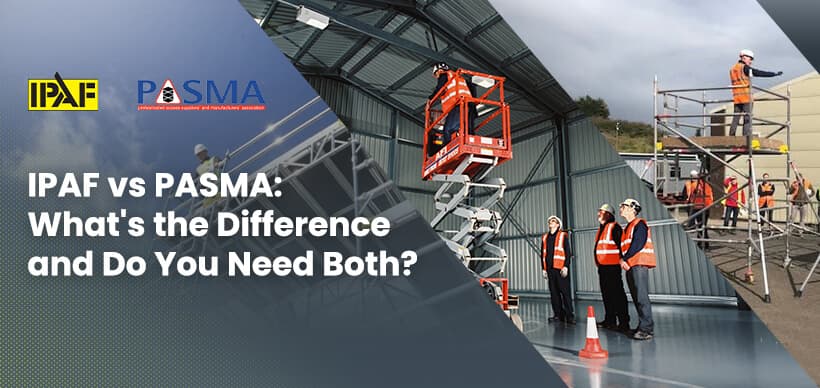
IPAF and PASMA are two well-known names in access equipment training, but they are not the same qualification.
A common question from workers and employers is: “Do I need IPAF or PASMA?” The answer depends mainly on the equipment you use and the work you carry out.
In simple terms, IPAF training mainly covers powered access equipment such as MEWPs, including scissor lifts and boom lifts. PASMA training focuses mainly on mobile access towers and other types of tower and low-level access equipment.
This means a worker using a scissor lift may need IPAF training, while someone assembling and using a mobile access tower may need PASMA training.
Some workers may use both types of equipment. In that case, IPAF and PASMA training may be appropriate because one qualification does not automatically cover the other.
This guide explains the difference between IPAF and PASMA, what each qualification covers, how the cards work and when you may need both.
For a wider introduction to PASMA courses and qualifications, see our PASMA Training Explained: The Complete Guide to Courses, Cards & Certification.
What Is IPAF?
IPAF stands for the International Powered Access Federation.
IPAF focuses on the safe and effective use of powered access equipment. Its training covers equipment such as Mobile Elevating Work Platforms (MEWPs) and other powered access categories.
IPAF operator training is designed for people who need to operate powered access equipment safely.
Successful candidates receive a PAL Card, which records the machine categories they have been trained to operate. IPAF says its operator training is available for several MEWP categories and that the PAL Card is internationally recognised.
IPAF training categories include:
● Static Vertical – 1A
● Static Boom – 1B
● Mobile Vertical – 3A
● Mobile Boom – 3B
● Push Around Vertical – PAV
● Specialist Machines
● Other specialist powered access categories
The exact category required depends on the machine.
What Is PASMA?
PASMA stands for the Prefabricated Access Suppliers' and Manufacturers' Association.
PASMA is recognised as an authority for mobile access towers and provides an industry-standard training scheme for tower users and managers.
PASMA training is mainly concerned with mobile access towers, low-level access equipment and different tower configurations.
The standard Towers for Users course covers areas such as:
● Tower assembly
● Tower dismantling
● Safe movement
● Inspection
● Safe use
● Hazard identification
● Relevant standards and guidance
PASMA states that Towers for Users is a one-day course with both theory and practical assessment. Successful delegates receive a PASMA PhotoCard and Certificate.
IPAF vs PASMA: The Main Difference
The easiest way to understand the difference is to look at the equipment.
Area | IPAF | PASMA
Main focus | Powered access | Mobile access towers and related tower equipment
Common equipment | Scissor lifts, boom lifts and other MEWPs | Mobile access towers, low-level access and specialist towers
Main operator card | PAL Card | PASMA PhotoCard
Typical operator | MEWP operator | Tower user
Practical training | Yes for operator qualifications | Yes for user qualifications
Machine categories | 1A, 1B, 3A, 3B and others | T, L, W and specialist tower categories
Main purpose | Safe operation of powered access | Safe use and assembly of access towers
Do they replace each other? | No | No
The two organisations cover different types of access equipment.
Having an IPAF PAL Card does not automatically mean that a worker is trained to assemble a PASMA tower.
Likewise, holding a PASMA qualification does not automatically qualify someone to operate a powered MEWP.
What Equipment Does IPAF Cover?
IPAF training is associated with powered access equipment.
Some of the most familiar machines include:
See our IPAF guide: The Complete Guide to IPAF Training: Courses, Categories & Certification.
● Scissor lifts
Scissor lifts are generally covered by the 3A Mobile Vertical category.
IPAF identifies 3A as the category for mobile vertical platforms, including scissor lifts.
● Boom lifts
Boom-type machines are generally covered by categories such as 1B Static Boom and 3B Mobile Boom, depending on the machine and its movement characteristics.
● Static vertical platforms
These can fall under the 1A Static Vertical category.
Push-around vertical platforms
These can fall under the PAV category.
● Specialist machines
Some machines have specialist categories, so the correct training should always be selected according to the equipment being used.
IPAF's current category guidance confirms that the machine category shown on the PAL Card identifies the equipment the operator has been trained to operate.
What Equipment Does PASMA Cover?
PASMA focuses on access towers and related equipment.
The standard Towers for Users course covers mobile access towers.
PASMA also provides courses for different tower configurations and equipment types.
These include:
● Mobile access towers
● Low-level access equipment
● Towers on stairways
● Linked towers
● Towers with cantilevers
● Towers with bridges
● Large deck towers
● Other specialist tower configurations
PASMA's training system uses categories on the PASMA card to show what the person has been trained to use or assemble.
For example, the standard Towers for Users category is shown as T, while Low-Level Access is L.
Specialist categories include configurations such as towers on stairways and linked towers.
IPAF Categories Explained
IPAF uses specific machine categories to identify the equipment covered by the training.
Area | IPAF | PASMA
Main focus | Powered access | Mobile access towers and related tower equipment
Common equipment | Scissor lifts, boom lifts and other MEWPs | Mobile access towers, low-level access and specialist towers
Main operator card | PAL Card | PASMA PhotoCard
Typical operator | MEWP operator | Tower user
Practical training | Yes for operator qualifications | Yes for user qualifications
Machine categories | 1A, 1B, 3A, 3B and others | T, L, W and specialist tower categories
Main purpose | Safe operation of powered access | Safe use and assembly of access towers
Do they replace each other? | No | No
IPAF confirms that these categories are used to identify the machine types covered by operator training.
The category on the PAL Card matters.
For example, a worker trained for 3A should not assume that the same training automatically covers every type of boom lift.
The employer should check that the worker has the relevant category for the machine being operated.
PASMA Categories Explained
PASMA uses its own categories.
For standard tower users, the main categories include:
PASMA category | Training area
T | Towers for Users
L | Low-Level Access
W | Work at Height – Novice
A5 | Towers on Stairways
A6 | Towers with Cantilevers
A7 | Towers with Bridges
A8 | Linked Towers
A9 | Large Deck Towers
PASMA explains that the category shown on the card identifies the training completed and therefore the tower configurations the user has been trained to assemble.
This is important because PASMA training is not one universal qualification covering every type of tower.
A worker may need additional training if their work involves a specialist tower configuration.
PAL Card vs PASMA Card
One of the easiest ways to understand IPAF vs PASMA is to compare their cards.
IPAF PAL Card
The PAL Card is issued after successful completion of relevant IPAF training.
The card records the machine categories the operator has been trained to operate.
IPAF also provides an online card verification system, allowing employers and site managers to check a PAL Card and its machine categories.
The PAL Card is therefore closely linked to powered access operator competence.
● PASMA PhotoCard
The PASMA PhotoCard records the PASMA training categories completed by the holder.
For example, a person who completes Towers for Users will have the relevant category shown on their PASMA card.
PASMA explains that employers can check the card to identify the user's training level and categories.
The PASMA card is therefore linked to tower training and competence.
Do IPAF and PASMA Cover the Same Equipment?
No.
There can be confusion because both organisations deal with work at height and access equipment.
However, the equipment is different.
A scissor lift is powered access equipment and is covered by IPAF's 3A category.
A mobile access tower is covered by PASMA tower training.
The fact that both may be used for maintenance or construction work does not make their training interchangeable.
This is why employers should identify the actual equipment before deciding which training is needed.
Do You Need IPAF or PASMA?
Ask one simple question:
What equipment will you use?
If you will operate a powered MEWP, you may need IPAF training in the relevant machine category.
If you will assemble, dismantle or use a mobile access tower, you may need PASMA training for the relevant tower category.
For example:
Your work | Training to consider
Operate a scissor lift | IPAF 3A
Operate a self-propelled boom | IPAF 3B
Operate a static boom | IPAF 1B
Use a standard mobile access tower | PASMA Towers for Users
Use low-level access equipment | PASMA Low-Level Access
Use a tower on stairs| PASMA specialist course
Manage tower users | PASMA Towers for Managers
The exact requirement should always be checked against the equipment, job and employer's site requirements.
Do You Need Both IPAF and PASMA?
You may need both if your job involves both types of equipment.
For example, consider a maintenance worker who:
● Uses a scissor lift for high-level work
● Uses a mobile access tower for smaller internal tasks
● Works across different areas of a building
The worker may need relevant IPAF training for the scissor lift and PASMA training for the tower.
One qualification does not replace the other.
Having both can therefore make sense when the worker regularly uses both powered access and tower equipment.
However, there is no reason to take both courses simply because they are both related to working at height.
Training should be based on the equipment and responsibilities involved.
IPAF and PASMA Combined Course: Are They the Same?
You may see companies searching for an IPAF and PASMA combined course.
This wording can be confusing.
An IPAF qualification and a PASMA qualification remain separate training schemes because they cover different equipment.
A training provider may offer both courses as part of a wider training programme or allow an employer to book them together.
That does not mean they become one single qualification.
For example, an employee might complete:
IPAF 3A + PASMA Towers for Users
This means the worker has completed relevant training for both a mobile vertical MEWP and a mobile access tower.
The two qualifications should still be recorded separately.
Is IPAF Better Than PASMA?
Neither is "better".
They are designed for different equipment.
Comparing them as if they were competing qualifications can therefore be misleading.
If you need to operate a scissor lift, PASMA does not replace IPAF.
If you need to assemble a mobile access tower, IPAF does not replace PASMA.
The better question is:
Which equipment do I need to use safely?
Once you know that, the correct training becomes much clearer.
IPAF Training for Scissor Lift Operators
Scissor lifts are commonly associated with IPAF 3A.
IPAF identifies 3A as the Mobile Vertical category and specifically includes scissor lifts.
IPAF's MEWP Operator Training can take between one and three days depending on the categories and training requirements. Successful candidates receive a PAL Card. IPAF also currently offers e-learning, in-person or virtual options for the theory section of its operator course.
The practical element remains important because the operator must demonstrate safe machine operation.
IPAF Training for Boom Lift Operators
Boom lifts fall into relevant IPAF boom categories depending on the machine.
A self-propelled boom is generally associated with 3B Mobile Boom, while certain static boom machines fall under 1B Static Boom.
The correct category should be confirmed against the actual machine.
The PAL Card shows the categories for which the operator has been trained.
This helps employers and site managers confirm whether the worker has the appropriate operator qualification.
PASMA Training for Mobile Tower Users
PASMA Towers for Users is designed for people who use mobile access towers.
The course covers both theory and practical work.
Delegates learn how to:
● Assemble towers safely
● Dismantle towers
● Move towers correctly
● Inspect towers
● Identify hazards
● Use towers safely
PASMA lists the course as one day with a practical assessment and a theory assessment.
This makes it different from IPAF training, which focuses on powered access equipment.
PASMA Low-Level Access vs IPAF
Low-level access equipment can include podium-type equipment and other platforms designed for lower working heights.
PASMA's Low-Level Access course covers equipment under 2.5 metres and includes both theory and practical training.
This should not be confused with IPAF training for powered MEWPs.
The equipment may both provide access to a working height, but their design and operation are different.
The correct training should therefore follow the equipment being used.
Can an IPAF Operator Use a PASMA Tower?
Not automatically.
Having a PAL Card does not mean that a worker has PASMA tower training.
If the worker needs to assemble, dismantle, alter or move a mobile access tower, the appropriate PASMA training should be considered.
PASMA states that the card category shows which types of towers the person has been trained to assemble.
An employer should not assume that general experience with powered access makes someone competent to build a tower.
Can a PASMA Trained Worker Operate a Scissor Lift?
Not automatically.
PASMA training does not qualify someone to operate a powered MEWP.
A worker who needs to operate a scissor lift should have the appropriate IPAF training category, such as 3A where applicable.
The PAL Card records the machine categories for which the operator has been trained.
This is why employers should check the card rather than relying on a worker saying they have "access training".
IPAF vs PASMA for Construction Workers
Construction workers may encounter both types of equipment.
A site may use:
● Scissor lifts
● Boom lifts
● Mobile access towers
● Low-level access equipment
If one worker uses several types of equipment, they may require different qualifications.
For example:
Scissor lift → IPAF 3A
Boom lift → relevant IPAF boom category
Mobile tower → PASMA Towers for Users
The training should reflect the equipment the worker is actually expected to use.
IPAF vs PASMA for Maintenance Workers
Maintenance work can also involve several access solutions.
A facilities or maintenance worker might use a scissor lift for one task and a mobile tower for another.
In this situation, having both qualifications may be useful.
However, employers should avoid training workers on equipment they will never use.
A better approach is to identify the common tasks and equipment used by the team, then select training accordingly.
What About Managers?
Managers may need different training from operators and tower users.
IPAF offers training for people who manage MEWP operations, while PASMA has a Towers for Managers course for people who manage or supervise tower users.
PASMA's Towers for Managers course is aimed at people such as site managers, safety professionals and company directors who manage tower operations rather than physically using towers themselves.
This means a manager may need different training from the employee operating the equipment.
IPAF vs PASMA: Which One Should an Employer Choose?
Employers should start with a simple equipment audit.
List the equipment workers are expected to use.
For example:
Equipment used by employees | Relevant training
Scissor lift | IPAF 3A
Mobile boom lift | IPAF 3B
Static boom | IPAF 1B
Mobile access tower | PASMA Towers for Users
Low-level access | PASMA Low-Level Access
Tower on stairs | PASMA Towers on Stairways
Supervising tower users | PASMA Towers for Managers
Then check whether individual employees need more than one qualification.
This approach is more useful than deciding on IPAF or PASMA first.
Do IPAF and PASMA Cards Expire?
Both schemes have qualification periods, and employers should monitor expiry dates.
IPAF states that its operator licence is generally valid for five years, subject to regional variations.
PASMA currently lists many qualifications with a five-year qualification length, although it also notes that this may vary regionally.
Employers should maintain records of:
● Qualification type
● Category
● Issue date
● Expiry date
● Employee name
● Equipment covered
Workers should also check that their card remains valid before starting work.
For a detailed explanation of PASMA cards and certification, see our PASMA Card & Certificate: How to Get, Check & Renew Your PASMA Ticket.
IPAF vs PASMA Training: A Simple Decision Guide
Use this quick guide:
Do you operate a powered MEWP?
→ Look at IPAF training.
Do you assemble, dismantle or use a mobile access tower?
→ Look at PASMA training.
Do you use both?
→ You may need both IPAF and PASMA.
Do you only manage tower users?
→ Consider PASMA Towers for Managers.
Do you manage MEWP operations?
→ Consider the relevant IPAF management training.
The exact course should always match the equipment and responsibilities.
IPAF and PASMA Training with AFI Training
AFI Training provides access equipment training for businesses and individuals across the UK.
Its training services cover both IPAF and PASMA, allowing businesses to consider the training needs of workers who use different types of access equipment.
This can be particularly useful for companies whose teams use a mixture of MEWPs, mobile access towers and low-level access equipment.
AFI Training can help employers identify the appropriate course based on the equipment and responsibilities involved.
If your team uses both powered access and tower equipment, you can discuss whether separate IPAF and PASMA qualifications are appropriate for your workers.
The aim should always be to provide training that matches the equipment employees actually use.
FAQs About IPAF vs PASMA
What is the difference between IPAF and PASMA?
IPAF mainly focuses on powered access equipment such as MEWPs, including scissor lifts and boom lifts. PASMA focuses mainly on mobile access towers, low-level access and specialist tower configurations.
Is IPAF the same as PASMA?
No. They are separate training schemes covering different types of access equipment.
Do I need IPAF or PASMA?
It depends on the equipment you use. MEWP operators may need IPAF, while mobile tower users may need PASMA.
Do I need both IPAF and PASMA?
You may need both if your work involves both powered access equipment and mobile access towers.
Does IPAF cover mobile access towers?
No. IPAF focuses on powered access equipment. Mobile access tower training is covered by PASMA.
Does PASMA cover scissor lifts?
No. Scissor lifts are commonly covered by IPAF's 3A Mobile Vertical category.
What IPAF category is a scissor lift?
Scissor lifts are generally covered by IPAF 3A Mobile Vertical training.
What IPAF category is a boom lift?
The category depends on the type of boom lift. Self-propelled booms are generally associated with 3B, while certain static boom machines fall under 1B.
What is a PASMA card?
A PASMA PhotoCard records the PASMA training categories completed by the holder and helps show what tower-related training they have received.
What is a PAL Card?
A PAL Card is the Powered Access Licence issued following successful relevant IPAF training. It records the machine categories for which the operator has been trained.
Can an IPAF operator use a PASMA tower?
Not automatically. IPAF training does not replace the appropriate PASMA training for tower assembly or use.
Can a PASMA-trained worker use a scissor lift?
Not automatically. The worker needs the appropriate IPAF training for the MEWP category they are expected to operate.
Is there an IPAF and PASMA combined course?
A provider may arrange IPAF and PASMA training as part of a wider training programme, but the qualifications remain separate because they cover different equipment.
Is IPAF better than PASMA?
Neither is better. IPAF and PASMA serve different purposes. The correct qualification depends on the equipment and role.
Do IPAF and PASMA qualifications expire?
Many IPAF and PASMA qualifications are listed with a five-year validity period, subject to regional variations and the specific qualification. Always check the current card and training requirements.
Conclusion
IPAF vs PASMA is not really a choice between two competing qualifications.
They are designed for different types of access equipment.
IPAF focuses mainly on powered access equipment, including scissor lifts, boom lifts and other MEWPs. PASMA focuses mainly on mobile access towers, low-level access and specialist tower configurations.
If you only use a scissor lift, relevant IPAF training may be what you need.
If you assemble and use mobile access towers, PASMA training may be appropriate.
If your role involves both, you may need both IPAF and PASMA.
The most important step is to identify the equipment your workers will actually use and then select training that matches those machines and responsibilities.
A PAL Card should not be treated as proof of PASMA tower competence, and a PASMA card should not be treated as proof of MEWP operator competence.
Choosing the correct qualification helps employers maintain a clearer training record and gives workers the specific skills they need for the equipment they operate.